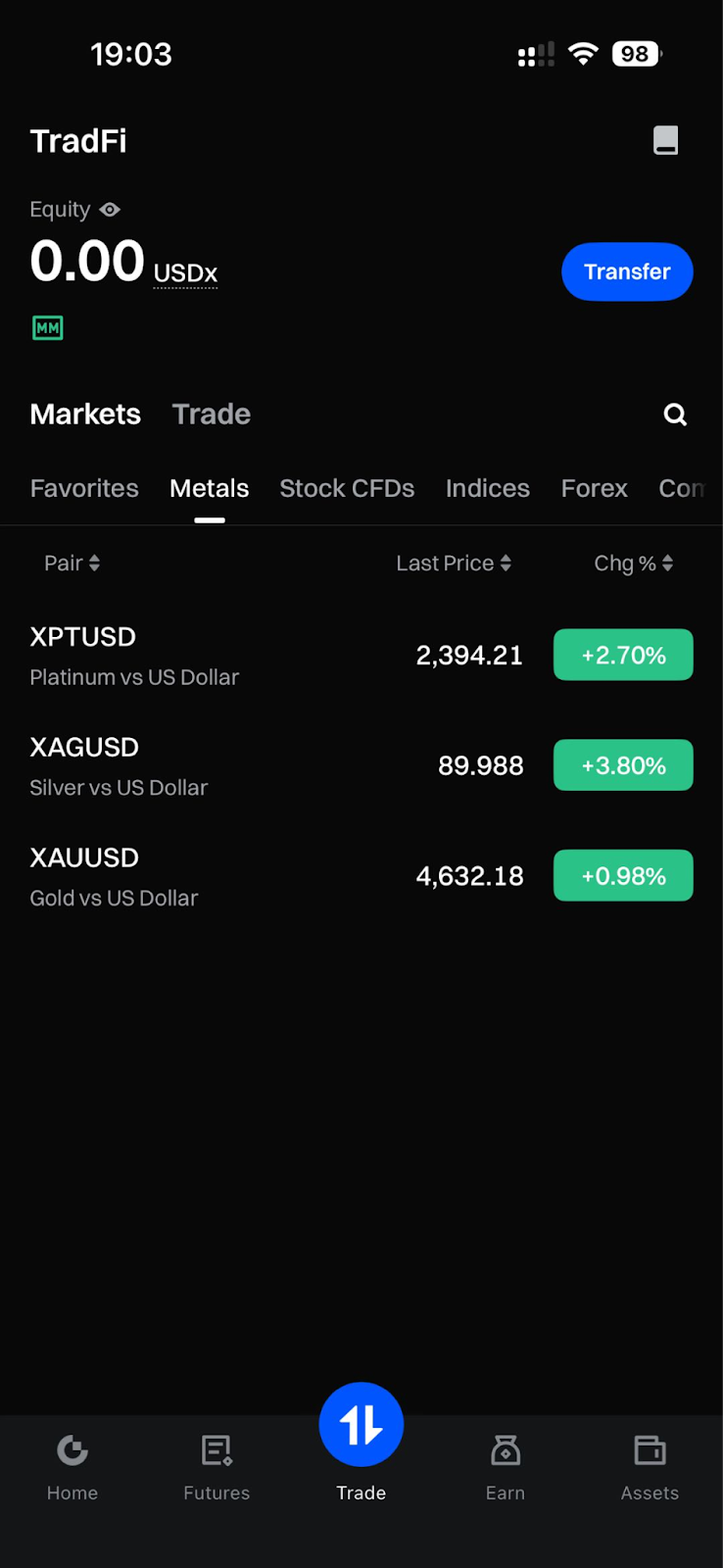
Gate is deepening its presence in TradFi, officially introducing CFD trading for traditional financial assets on the Gate App. This feature covers a wide range of products, including forex, gold, indices, commodities, and stocks. By integrating the USDx pricing system with the MT5 platform, Gate offers users a seamless, one-stop solution for multi-asset price trading and risk hedging.
Gate, a global leader in crypto asset trading, continues to expand its Traditional Finance (TradFi) offerings. The platform now provides users with contract-for-difference (CFD) trading services for foreign exchange, gold, indices, commodities, and select popular stocks. These features are fully integrated into the Gate App, allowing users to trade both digital assets and traditional financial instruments within a single account—eliminating the need to switch platforms.
This expansion marks Gate’s entry into the price discovery arena for traditional financial assets, further shaping a robust multi-asset trading ecosystem beyond crypto.
USDx as the Settlement Unit, Fully Backed by USDT
Gate TradFi contracts utilize USDx as the margin and account display unit. USDx is not a fiat currency or an on-chain crypto asset; it serves as an internal accounting unit for TradFi transactions on Gate and is pegged 1:1 to USDT.
When users transfer USDT to a TradFi account:
Account balances are shown in USDx
Funds are 100% backed by USDT
No additional conversion is required
No extra transaction or custody fees apply
This approach ensures unified pricing logic and significantly lowers the operational barrier for users.
Trading Rules Closely Mirror Traditional Financial Markets
Unlike perpetual crypto contracts, Gate TradFi contracts adhere to established CFD market conventions:
Defined trading hours and closing times
Fixed leverage multiples—manual adjustment not supported
Cross-margin model
Long and short positions within a trading pair can be hedged by lot size
Profit and loss settled at counterparty prices
Overnight fees apply to positions held across market closures
This rule set aligns with mainstream CFD markets and caters to the operational habits of traditional financial traders.
Leverage and Fee Structures for Major Asset Classes
Gate TradFi contracts support a broad range of conventional financial assets and offer differentiated leverage settings:
Forex, indices, and similar instruments: up to 500x leverage
Stock CFDs: up to 5x leverage
Gate TradFi offers highly competitive trading costs, with transaction fees starting at $0.018 per order. The transparent fee structure enables users to plan effectively for diverse trading strategies.
MT5 System Integration: Advanced Risk Control and Professional Trading Experience
Gate TradFi leverages MT5 (MetaTrader 5) for trading services, enabling seamless data synchronization between the Gate App and MT5 client:
Real-time synchronization of account assets
Consistent trading records
Support for advanced TradFi trading tools and interfaces
For risk management, the platform employs a forced liquidation mechanism based on margin ratio. If an account’s margin ratio drops to 50% or below, the system will gradually trigger forced liquidation according to predefined rules to manage overall risk exposure.
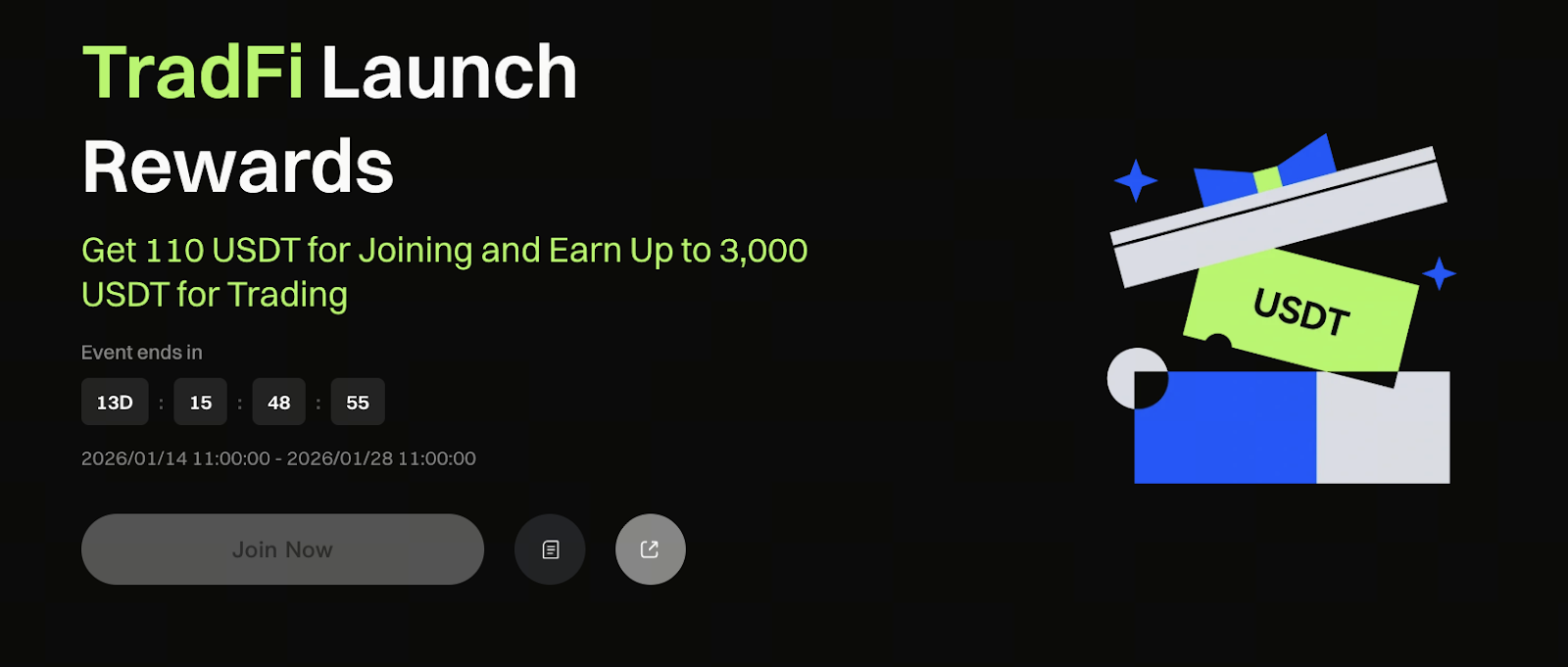
To facilitate a smooth TradFi contract trading experience, Gate has launched TradFi experience events:
Register to receive up to 110 USDT in experience rewards
Complete designated trades
Unlock up to 3,000 USDT in phased incentives
These incentives are designed to support users’ first TradFi trading experience and lower the participation threshold.
Gate TradFi Strategy for the Multi-Asset Trading Era
The addition of TradFi functionality expands Gate’s trading system from a crypto-only marketplace into traditional financial asset price trading. Users can conduct multi-asset price analysis, strategy execution, and risk hedging on a single platform, reducing the complexity of cross-platform operations.
As the distinction between crypto and traditional financial markets continues to blur, demand for multi-asset and cross-market trading is on the rise. The introduction and ongoing enhancement of Gate TradFi may become a cornerstone of the platform’s integrated trading infrastructure, providing new practical models for merging diverse asset classes within a compliant framework.
Author: Max
Disclaimer
* The information is not intended to be and does not constitute financial advice or any other recommendation of any sort offered or endorsed by Gate.
* This article may not be reproduced, transmitted or copied without referencing Gate. Contravention is an infringement of Copyright Act and may be subject to legal action.
Stablecoins were originally designed as dollar substitutes within exchanges, primarily used for asset pricing and trade settlement. As on-chain financial ecosystems have matured, their role has expanded beyond simple payments to include collateral assets, cross-chain liquidity mediums, and unified settlement units. In particular, as AI systems and automated agents begin to participate directly in economic activity, demand has risen sharply for programmable value units capable of instant settlement. This shift is pushing stablecoins toward the role of foundational financial infrastructure.
In the competition for DeFi liquidity, high-inflation mining alone is no longer enough to build lasting advantages. Aerodrome applies the ve(3,3) economic model to redesign token emissions, voting mechanisms, and revenue distribution, creating a liquidity flywheel centered on governance and cash flow. This article examines AERO tokenomics, the veAERO locking mechanism, and protocol revenue models to explain how Aerodrome builds a sustainable DeFi economic system.
PAXG (Pax Gold) is a tokenized asset backed by physical gold, issued by the fintech company Paxos and traded on the Ethereum blockchain as an ERC-20 token. The core concept is to tokenize physical gold on-chain, with each PAXG token representing ownership of a certain amount of gold. This structure enables investors to hold and trade gold in the form of a digital asset.
AERO is the native token of Aerodrome Finance, a core decentralized exchange and liquidity protocol in the Base ecosystem. It is primarily used for liquidity incentives and ecosystem operations. veAERO is a governance NFT that users receive by locking AERO, representing both voting power and the right to share protocol revenue. Through a dual track structure of AERO as a utility token and veAERO as a governance credential, Aerodrome separates liquidity usage value from long term governance power, allowing participants to act as liquidity providers, governance decision makers, and revenue sharers within the same system.
PAXG (Pax Gold) is a tokenized asset backed by physical gold reserves, launched by fintech firm Paxos and issued as an ERC-20 token on the Ethereum blockchain. The core concept is to digitally represent real-world gold assets, allowing investors to hold and trade gold via the blockchain network. Because each PAXG token corresponds to a specific quantity of physical gold, its price is theoretically expected to closely track the global gold market.
In the early stages of the crypto market, traditional stablecoins mainly relied on single-reserve or single-collateral models. Their primary focus was price stability and payment convenience, which allowed them to become foundational tools for on-chain trading and capital flows. As the market has entered a more mature financial phase, however, this structure has begun to reveal limitations, including high concentration risk and the difficulty of balancing liquidity with yield. These constraints have driven the evolution toward multi-layer collateral and portfolio-based designs, such as the dual-layer hybrid collateral architecture proposed by United Stables, which seeks to redefine the underlying logic of stable assets.