Multi-chain and Layer 2 solutions have consistently faced the tension between “fast ordering with weak confirmation” and “strong confirmation with long waiting times.” Centralized sequencers offer soft confirmations in seconds but depend on the operator’s reputation, while L1 finality is more robust but often requires a longer wait. HotShot shifts confirmation responsibility to a decentralized set of staked validators, targeting composable finality within seconds.
To understand HotShot, you need to grasp three core principles: consensus governs only order and confirmation; execution and data availability (DA) are decoupled; and optimistic responsiveness reduces latency. It's also essential to recognize what second-level finality means for cross-chain and financial use cases.
What Is HotShot? What Does It Do in Espresso?
HotShot serves as the BFT consensus protocol for Espresso Network (ESP), inheriting its design from HotStuff and HotStuff-2. Leaders propose blocks, validators reach quorum certificates through multiple rounds of voting, and, under the honest majority assumption, achieve final agreement on block ordering.
Within Espresso’s architecture, HotShot is responsible for settlement and confirmation: it generates a unified, verifiable final record of transaction outputs submitted by integrated environments. Each application or chain maintains its own execution environment, ordering strategy, and compliance rules. Espresso doesn’t force all state into a single shared machine; instead, multiple parties share a common finality foundation.
| HotShot Component |
Role in Espresso |
| BFT Consensus Core |
Delivers decentralized final confirmation of block order |
| Validator Set |
Stakes ESP, votes, and produces blocks |
| Quorum Certificate |
Proves a supermajority of staked validators approved a block |
| Execution Layer (External) |
Each app/chain manages its own state transitions |
| DA Layer (Separable) |
EspressoDA is default; other solutions are optional |
This table clarifies the division of labor between HotShot and surrounding modules: consensus provides proof that “order is finalized,” while execution and data availability are modular and composable. Security depends on staking weight—compromising results typically requires controlling at least two-thirds of staked ESP. ESP staking and protocol fees detail how validator staking, thresholds, and penalties support this model.
How Does HotShot Work? Why Focus on Optimistic Responsiveness?
HotShot’s steady-state process is as follows: the ordering module submits blocks or transaction streams → the leader packages and broadcasts them → validators vote to form certificates → once a quorum is reached, the block is finalized. Unlike protocols with fixed block intervals, HotShot emphasizes optimistic responsiveness: when network conditions are good and messages are prompt, the protocol advances at actual propagation speed, without reserving conservative timeouts for worst-case scenarios.
Optimistic responsiveness means that, under favorable conditions, latency can approach a few network round trips, rather than being artificially extended to the longest possible delay. HotStuff-2 further reduces the rounds needed for view changes and certificate paths, making “finality in three network round trips” feasible in practice. In adverse conditions, the protocol defaults to a timeout-based path to maintain safety and liveness.
| Attribute |
Optimistic Responsive (HotShot) |
Non-Responsive Fixed Interval (Example) |
| Advancement Pace |
Progresses at network speed when conditions are good |
Fixed slot/block time |
| Good Network Latency |
Can be reduced to seconds or less |
Still limited by fixed intervals |
| Worst Case |
Relies on timeouts and view changes |
Always runs with conservative parameters |
| CDN Integration |
Can accelerate certificate/data distribution |
Typically lacks such integration |
This table contrasts the two pacing approaches. HotShot’s protocol is designed to be “fast on average,” often integrating network accelerators like CDNs. The shared sequencing layer comparison explains why “fast confirmation” must involve a validator set, not just a single sequencer.
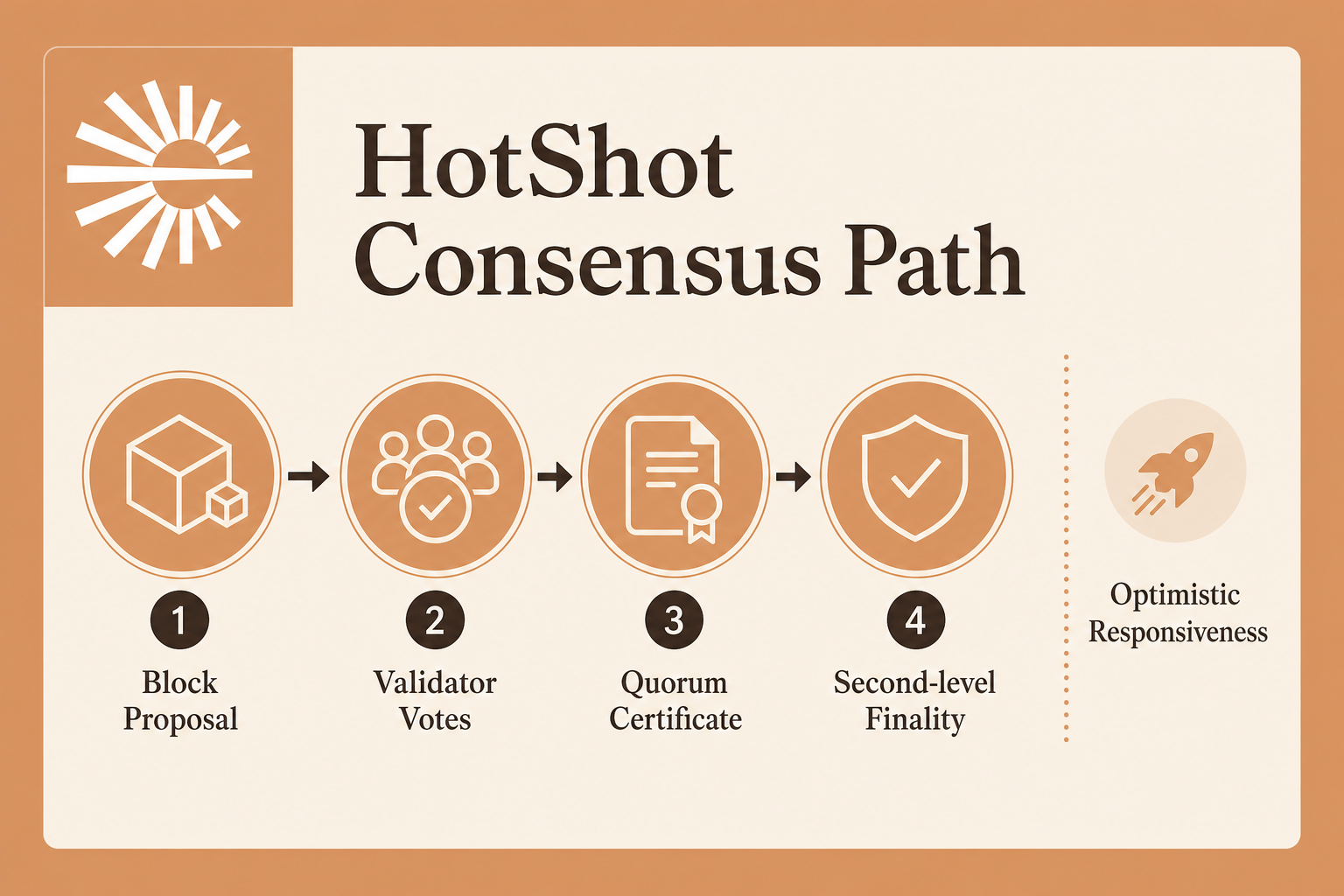 Figure 1. HotShot consensus path: block proposal → validator voting → quorum certificate → second-level finality. Optimistic responsiveness allows progress at network speed under good conditions.
Why Does HotShot Confirm Without Executing Transactions?
HotShot deliberately does not execute transactions: validators do not replay smart contracts or application state machines during consensus. What’s confirmed is that “a sequence is approved by a supermajority of staked validators,” not that “the state root is computed at this layer.” Once execution environments receive the finalized sequence, they derive state according to their own rules. Privacy applications can decrypt and execute only after authorized parties hold the keys.
This separation of confirmation and execution has two main outcomes. First, Espresso’s throughput is no longer bottlenecked by a single global executor—specialized environments can execute in parallel, while HotShot finalizes their output streams. Second, cross-environment collaboration can rely on verifiable messages (like zero-knowledge proofs), so target chains can verify source state correctness without duplicating all business logic on Espresso.
Data availability (DA) is also decoupled from consensus. Integrators can use EspressoDA (which includes verifiable information dispersal, DA committees, and CDN acceleration) or other DA solutions. HotShot focuses on ordering and certificates; DA ensures data can be retrieved. The second-level confirmation flow connects proposals, certificates, and downstream data retrieval into a complete confirmation path.
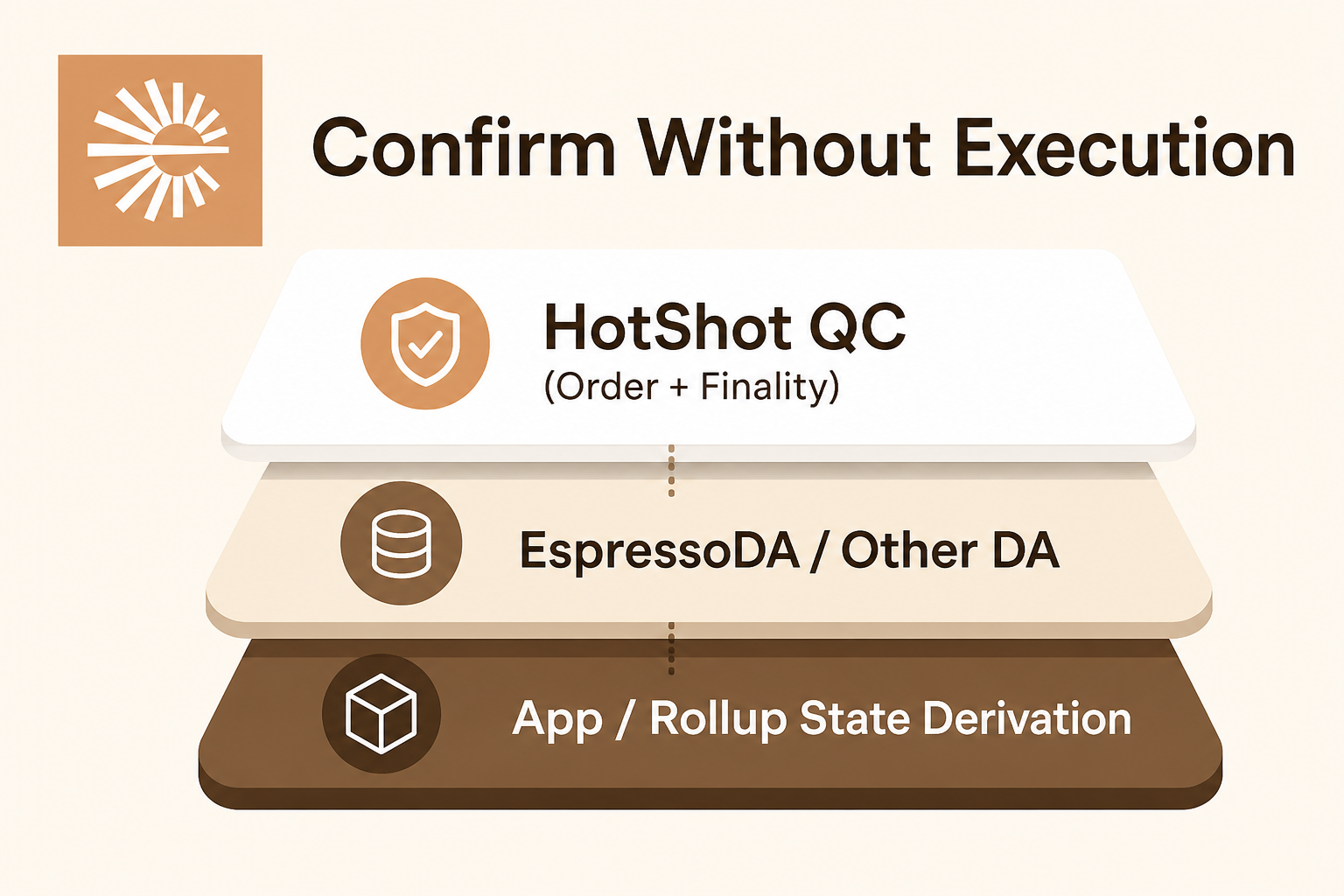 Figure 2. Separation of confirmation and execution: HotShot outputs order and quorum certificates, EspressoDA (or other DA) ensures data is retrievable, and applications derive state independently.
What Does Second-Level Finality Mean for Cross-Chain and Financial Use Cases?
Second-level finality means a transaction sequence is confirmed as non-reversible within seconds by a decentralized validator set. Unlike “sequencer soft confirmation,” HotShot finality is anchored by a supermajority of staked validators. Unlike some L1s with long finality, integrators don’t need to wait an entire epoch for strong confirmation. Mainnet documentation describes confirmation as typically within a few seconds (e.g., Mainnet 1 often cites under three seconds), but actual times depend on network load and version, so always refer to public network status and disclosures.
For cross-chain use cases, unified finality reduces the window where “one side considers a transaction final while the other can still reorganize,” making collateral monitoring, message passing, and liquidity routing easier to synchronize. For stablecoin issuance, payment networks, tokenized assets, and margin management, second-level confirmation shortens exposure and reconciliation delays, enabling real-time risk management and cross-system collateralization—provided execution, compliance, and key management remain under each app’s control.
What Are the Advantages and Limitations of HotShot?
HotShot’s main advantages are: decentralized finality is more auditable than single-sequencer models; optimistic responsiveness reduces confirmation latency under good network conditions; and separating confirmation, execution, and DA enables higher throughput and customization. Integrators can maintain their own VM, fee, and compliance settings while sharing the same settlement layer.
The limitations are also clear. HotShot doesn’t replace application-layer correctness: bad logic, faulty keys, or incorrect oracle inputs will still cause incorrect states. Liveness depends on network and validator participation; under extreme conditions, the protocol may fall back to slower timeout paths. Security depends on staking distribution and penalty mechanisms; validator concentration and client diversity are long-term factors. Poor DA choices or data retrieval failures can impact downstream execution and cross-chain verification, even if consensus certificates remain valid.
On the risk side, distinguish between: protocol risks (consensus assumption failures, implementation bugs), integration risks (ordering, bridging, proof systems), and operational risks (keys, permissions, compliance). The above outlines only the mechanism’s strengths and boundaries.
Summary
As the BFT consensus protocol for Espresso Network, HotShot delivers verifiable final transaction ordering secured by validator staking and achieves second-level finality through optimistic responsiveness. The protocol does not execute transactions, DA is modular, and execution remains within each application’s environment. Cross-chain and financial scenarios benefit from shorter, more consistent confirmation windows, but application correctness, staking distribution, network conditions, and DA choice remain critical boundaries.
FAQ
What is HotShot consensus?
HotShot is the Byzantine Fault Tolerant (BFT) consensus protocol used by Espresso Network, based on HotStuff and HotStuff-2. Validators vote on block order and form quorum certificates, providing final confirmation under the honest majority assumption. HotShot itself does not execute transaction state transitions.
How does Espresso achieve second-level finality?
Espresso leverages HotShot’s optimistic responsiveness and multi-round voting to advance consensus at network speed in good conditions, so mainnet confirmations generally occur within a few seconds. Finality is backed by a decentralized set of staked validators—not just a single sequencer’s soft confirmation.
What is Espresso Network?
Espresso Network is a settlement and confirmation infrastructure shared by multiple chains and applications. Each environment retains its own execution and rules, transaction outputs achieve decentralized finality through HotShot, and data availability and cross-chain messaging can be integrated to minimize reliance on trusted intermediaries.
What is the utility of the ESP token?
ESP is Espresso Network’s native utility token, primarily used for validator staking to secure HotShot and to participate in protocol fee mechanisms. Staking weight determines voting influence; compromising confirmation typically requires control of a significant portion of staked ESP.
What are the risks of using Espresso?
Major risks include: application logic or key errors are not automatically corrected by consensus; extreme network or validator behavior can slow confirmation; staking concentration and client vulnerabilities affect security; DA and bridging/proof component flaws can impact downstream availability. Risk assessments should distinguish between protocol and integration level risks.







