Caterpillar’s stock price performance cannot be explained solely by “global economic growth.” Construction equipment, mining machinery, and power and energy systems serve different end markets; when one segment weakens, others may provide growth support. Factors such as manufacturing costs, tariffs, product pricing, and dealer inventory can also cause revenue growth and profit changes to diverge.
According to Gate market data, CAT’s price has steadily risen from a stage low of around $270–$280 in April 2025, reaching approximately $1,050–$1,070 in late June to early July 2026. In the most recent week, CAT opened at $939.21, hit a high of $964.57, dropped to a low of $868.97, and closed at $877.29, down 7.86% for the week. This reflects the market entering a more pronounced phase of high-level volatility following a rapid price surge.

Why Does Construction Equipment Demand Impact CAT’s Stock Price?
CAT’s stock price is influenced by construction equipment demand because purchases by construction, mining, and industrial clients are typically capital expenditures. Customers only increase procurement of excavators, loaders, bulldozers, and mining equipment when projects start, equipment utilization rises, or existing fleets need replacement. As a result, end-user demand directly impacts Caterpillar’s sales and profit outlook.
The market pays attention not just to Caterpillar’s current shipments, but also to end-user retail sales, order backlogs, and dealer inventories. Caterpillar mainly sells equipment through independent dealers. Dealer restocking can temporarily boost company shipments, while destocking may cause company sales to lag behind actual end-user demand.
Rising construction equipment demand typically raises market expectations for capacity utilization and profit growth, but higher sales do not always translate directly into higher profits. Some Caterpillar business lines have seen sales growth offset by increased manufacturing costs, tariffs, and less favorable pricing, highlighting the need to assess how much incremental revenue ultimately becomes profit.
How Do Infrastructure Investment Cycles Affect Caterpillar’s Orders?
Infrastructure investment cycles primarily impact Caterpillar’s construction equipment orders through projects like roads, bridges, housing, industrial facilities, data centers, and public works. Contractors only ramp up equipment purchases after project budgets are approved, financing is secured, and construction officially begins—creating a time lag between policy announcements and real demand for equipment.
Public infrastructure projects tend to have longer cycles, continually driving demand for new equipment, parts, and after-sales services. Private construction investment is more sensitive to financing costs, real estate activity, and business confidence. When infrastructure investment expands, Caterpillar benefits from both construction equipment demand and ongoing maintenance needs; when projects slow, customers may delay fleet replacements.
AI data center construction is generating new demand for Caterpillar. In Q1 2026, company revenue grew 22% year-over-year to $17.42 billion, with construction industries sales up 38% and energy & transportation sales up 22%. Management also raised long-term growth expectations, identifying data centers, power generation, and critical infrastructure as key drivers.
How Does Mining Capital Expenditure Impact CAT’s Business Growth?
Mining capital expenditures drive CAT’s business growth because resource companies base large mining truck, extraction equipment, and parts purchases on metal prices, mine output targets, project ROE, and equipment replacement cycles. Mining projects have long construction cycles and large order sizes, so changes in capital budgets significantly affect Caterpillar’s resource industries segment.
When prices for copper, iron ore, gold, and other resources remain high, mining companies are more likely to expand and update equipment. However, rising commodity prices only translate into new machinery orders if miners believe demand will persist and project returns will cover costs.
Mining equipment also generates strong after-sales service revenue. Large mining machinery requires ongoing maintenance, replacement parts, and digital operation support. Even if new equipment orders fluctuate, the installed base can continue generating parts and service revenue. Caterpillar’s resource industries business covers open-pit and underground mining, heavy construction, quarrying, and aggregates.
How Do Commodity Prices Shift Market Expectations for Caterpillar?
Commodity prices shape market expectations for Caterpillar’s profitability, but not in a simple one-to-one relationship. Rising metals and energy prices can boost resource companies’ cash flow, improve the economics of mine expansion, oil and gas development, and equipment upgrades, all of which can strengthen expectations for Caterpillar’s future orders.
Falling commodity prices can prompt customers to cut capital spending or delay large projects, especially at high-cost mines and energy operations. Since equipment procurement plans usually precede revenue recognition, CAT’s price may respond to commodity cycle changes before Caterpillar’s financial statements do.
| Market Variable |
Impact on Customer Decisions |
Potential Impact on CAT Market Expectations |
| Rising metal prices |
Increases mine expansion willingness |
Strengthens resource industries order outlook |
| Rising energy prices |
Improves oil & gas project economics |
Supports power equipment and service demand |
| Falling commodity prices |
Delays high-cost projects |
Lowers equipment sales expectations |
| Sharp price volatility |
Reduces capital budget certainty |
Increases CAT price volatility |
| Long-term critical mineral demand |
Drives new mines and expansions |
Supports mid- to long-term equipment replacement |
Investors must distinguish short-term commodity price swings from long-term supply and demand changes. A one-month price rebound may not alter mining companies’ multi-year capital plans. Long-term trends—such as electrification, infrastructure renewal, and critical mineral demand—typically have a more lasting effect on equipment procurement cycles.
How Does the Interest Rate Environment Affect Construction Equipment Demand?
Interest rates affect construction equipment demand by impacting financing costs, project ROE, and customer cash flow. Building contractors and small to midsize equipment buyers often rely on loans or leasing. Higher rates raise financing costs and may make lower-return projects less attractive.
Higher rates can also dampen real estate development, commercial construction, and private infrastructure investment, reducing equipment utilization. Even if public infrastructure and mining orders stay steady, weaker private sector demand may impact dealer restocking and Caterpillar’s construction industries revenue.
Rate cuts do not guarantee a rise in CAT’s price, as the market weighs whether cuts are due to easing inflation or a clear slowdown in economic activity. If lower rates coincide with weaker construction, manufacturing, and mining, improved financing may not fully offset declining end-user demand.
How Does CAT Stock Valuation Reflect Cyclical Changes?
CAT’s stock valuation reflects the market’s view of future orders, margins, and cash flow—not just a simple multiple of current revenue. During an upcycle, investors may boost profit expectations in advance. Once prices fully reflect growth prospects, strong operating data may not prevent valuations from pulling back if expectations are too high.
According to Gate market data, CAT’s price climbed from about $270–$280 in April 2025 to $1,050–$1,070 in late June to early July 2026. This rally reflects not only traditional construction and mining demand, but also the market’s forward pricing of data center construction, power equipment demand, and long-term order growth. In Q1 2026, Caterpillar’s order backlog hit a record $62.7 billion, further boosting visibility into future revenue.
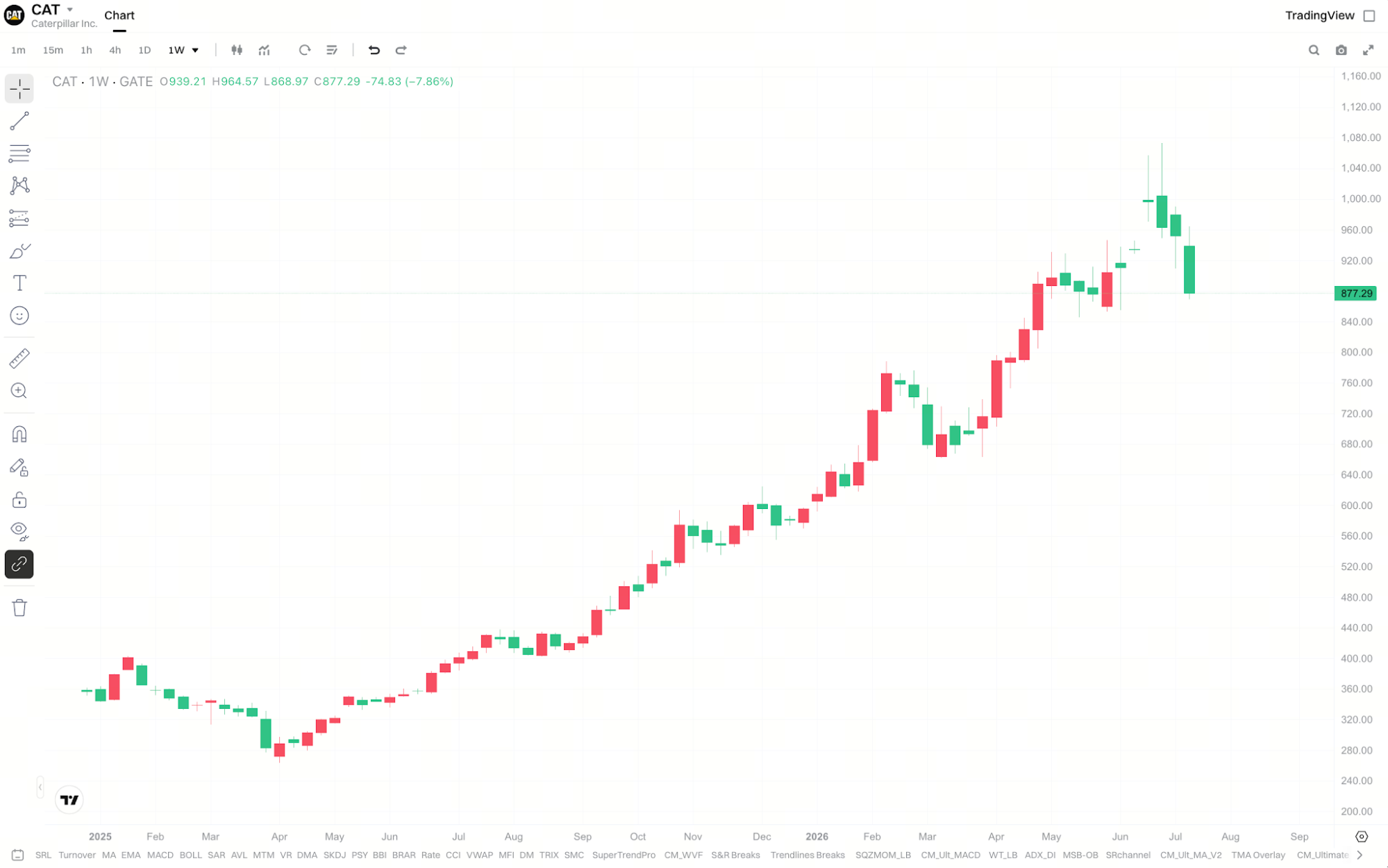
In the most recent week, CAT opened at $939.21, hit a high of $964.57, fell to a low of $868.97, and closed at $877.29, down 7.86% for the week. This shows that after a sharp rally, the market is reassessing whether order growth can continue to drive higher margins and cash flow, and whether current valuations already price in a lot of optimism.
| Valuation Variable |
Typical Market Focus |
| Order backlog |
Is future revenue sufficiently visible? |
| Operating margin |
Can sales growth translate into profit? |
| Service revenue |
Can the business model buffer equipment cycles? |
| Operating cash flow |
Are dividends, buybacks, and expansion sustainable? |
| Dealer inventory |
Is shipment growth driven by real end-user demand? |
| Valuation multiple |
Has the market already priced in the upcycle? |
CAT may show “strong results, limited price reaction” near cycle peaks, as growth is already priced in; conversely, at cycle lows, financial data may remain weak even as prices rebound in anticipation. This forward-looking feature is key to understanding how industrial cyclical stocks are priced.
What Are the Cyclical Risks for Caterpillar Stock?
The main cyclical risks for Caterpillar stock include falling construction equipment demand, reduced mining capital expenditures, dealer destocking, and margin pressure. When multiple end markets slow at once, Caterpillar’s diversification across construction, resources, and energy may not fully offset declines in equipment orders.
Manufacturing costs and trade policy can also amplify cyclical swings. In Q4 2025, Caterpillar’s revenue grew 18%, but operating margin fell from 18.0% a year earlier to 13.9%. Profits in construction and resource industries were hit by higher tariffs and manufacturing costs, showing that strong sales and profit improvement may diverge.
After a rapid rally, CAT’s price also faces valuation correction risk. If data center power demand, infrastructure investment, or mining orders fall short of expectations, investors may lower long-term growth assumptions. The recent 7.86% weekly drop reflects greater sensitivity to expectation changes at high valuations, but a single week’s volatility does not determine long-term business trends.
Summary
CAT’s stock movements fundamentally reflect the market’s reassessment of Caterpillar’s future equipment orders, margins, and cash flow. Infrastructure investment, mining capital expenditures, commodity prices, interest rates, and demand from data centers and energy collectively determine whether customers will expand equipment purchases.
According to Gate market data, CAT’s price rose from about $270–$280 in April 2025 to $1,050–$1,070 in late June to early July 2026, showing a significant market repricing of Caterpillar’s growth outlook. The latest weekly close at $877.29, down 7.86%, indicates the market is now scrutinizing valuations, profit realization, and cycle sustainability more rigorously.
Caterpillar boasts a global dealer network, a massive installed equipment base, and recurring service revenue, but remains a cyclical industrial company. Analyzing CAT stock requires a holistic view—end-user demand, dealer inventory, order backlog, manufacturing costs, cash flow, and valuation levels—rather than relying on a single macro metric or short-term price moves.
FAQ
Does a rise in CAT’s price always mean the global economy is accelerating?
A rise in CAT’s price does not always indicate broad global economic acceleration; it can also be driven by data center construction, power equipment demand, specific regional infrastructure projects, or increased mining orders.
Is an increase in dealer inventory always a positive for CAT?
An increase in dealer inventory is not always positive. Active restocking may signal improving demand, but if end-user sales are weak, rising inventory could lead to reduced dealer purchases later.
Why can Caterpillar’s profit margin fall even as revenue rises?
Caterpillar’s profit margin can fall even as revenue rises because higher tariffs, material, labor, and logistics costs may offset the profit benefits of higher sales and price increases.
Why does AI data center construction impact CAT?
AI data center construction increases demand for construction, backup power, and on-site power equipment. Caterpillar participates through construction machinery, engines, gas turbines, and power generation systems.
Is CAT stock suitable for valuation by P/E ratio alone?
CAT stock should not be valued by P/E ratio alone, as peak cycle profits may be overstated. Analysis should also consider order backlog, cash flow, margins, and industry cycle position.
Why do commodity prices and CAT sometimes move differently?
Commodity prices and CAT can move differently because equipment procurement depends on customers’ long-term capital budgets, while CAT also reflects construction demand, costs, interest rates, and valuation shifts.