Xiaomi Corporation is listed in Hong Kong and is commonly associated with the Hong Kong stock code 1810. For users who already hold USDT, Gate Stocks creates a way to access Xiaomi Hong Kong Stock through a digital asset account environment instead of opening a separate traditional Hong Kong securities brokerage account first.
The difference between buying Xiaomi Hong Kong stocks on Gate and using traditional Hong Kong stock brokers is not only about where the order is placed. It also involves account setup, settlement asset, market-hour access, dividend treatment, voting rights, transfer assumptions, account records, regional eligibility, and product-rule verification.
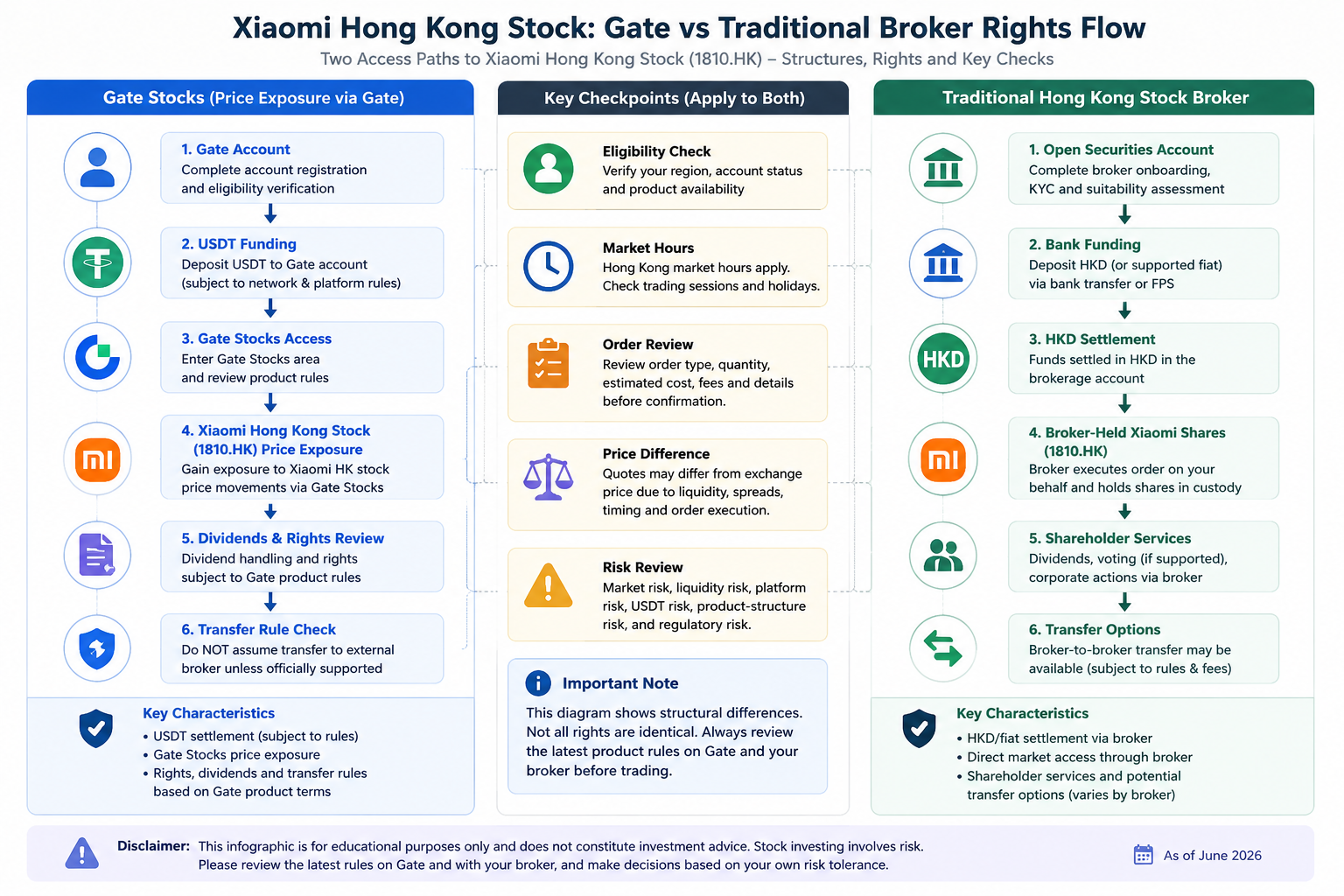
What Is the Key Difference Between Buying Xiaomi Hong Kong Stock on Gate and Using a Traditional Hong Kong Stock Broker?
The key difference is the access model. Gate Stocks allows users to access Xiaomi Hong Kong Stock price exposure through Gate’s product structure, while a traditional Hong Kong stock broker usually provides access through a securities account connected to fiat funding, broker custody, and market infrastructure.
On Gate, users may use USDT as the funding asset, subject to product rules and account eligibility as of June 2026. This can be relevant for users who already hold digital assets and want to access Hong Kong stock price exposure without first moving funds into a traditional broker. The related tutorial on buying Xiaomi Stock with USDT shows the broader product flow for users who want to understand the buying process.
A traditional Hong Kong broker normally uses a different setup. Users may need to open a securities account, complete broker onboarding, connect a bank account, fund the account in HKD or another supported fiat currency, and place orders during Hong Kong market hours. The broker may also provide securities statements, tax-related documents, voting services, transfer options, and corporate-action handling, depending on the broker’s service model.
This means the two methods should not be treated as identical. Gate may be more suitable for users who want USDT-funded stock price exposure inside a crypto-native account. A traditional broker may be more suitable for users who need direct securities-account services, formal brokerage statements, shareholder voting workflows, or broker-to-broker transfer options.
How Buying Xiaomi Hong Kong Stock on Gate Works
Buying Xiaomi Hong Kong Stock on Gate works through Gate Stocks, a product structure that connects users to stock price exposure inside the Gate account environment. The user does not start from a conventional Hong Kong brokerage account. Instead, the process usually begins with a Gate account, account eligibility review, USDT funding, access to the Stock Account area, stock search, order review, and order confirmation.
The broader concept behind Gate Stocks trading is that users can access selected stock exposure products through Gate rather than through a traditional securities broker. For Hong Kong-listed stocks, the settlement and order experience may differ from direct broker access because the user is interacting with Gate’s product interface, account records, and product rules.
A typical preparation checklist should include the following points:
| Preparation Item |
What Users Should Check Before Buying Xiaomi Hong Kong Stock on Gate |
| Stock name and code |
Xiaomi Hong Kong Stock, commonly associated with 1810.HK |
| Product type |
Gate Stocks price exposure, not a traditional broker account |
| Funding asset |
USDT-based funding flow, subject to Gate rules as of June 2026 |
| Account access |
Gate account, Stock Account access, and eligibility review |
| Trading session |
Hong Kong stock market hours and Gate product availability as of June 2026 |
| Dividend rules |
Verify the latest Gate Stocks dividend handling rules before trading |
| Voting rights |
Verify whether voting rights apply under Gate’s current product structure |
| Transfer rules |
Do not assume transfer to an external broker unless officially supported |
| Regional availability |
Check whether the product is available in the user’s region |
| Risk review |
Review market, liquidity, price difference, platform, USDT, and product-structure risks |
These preparation points matter because the purchase button is only one part of the user journey. A user also needs to understand how the position is funded, how it is recorded, how price exposure is created, what rights may or may not apply, and whether future transfer or broker-level documentation is required.
How Gate Stocks Compare With Traditional Hong Kong Stock Brokers
The comparison between Gate Stocks and traditional Hong Kong stock brokers should focus on structure, not on which option is better. Gate and traditional brokers serve different user needs. Gate Stocks may suit users who already operate in a digital asset environment and want a simplified USDT-funded route to Xiaomi Hong Kong Stock price exposure. Traditional brokers may suit users who need a full securities-account framework.
| Comparison Dimension |
Xiaomi Hong Kong Stock on Gate |
Traditional Hong Kong Stock Broker |
| Access method |
Gate Stocks through a digital asset account |
Securities account through a broker |
| Funding asset |
USDT-based funding flow, subject to product rules |
Usually HKD or broker-supported fiat |
| Price exposure |
Exposure to Xiaomi Hong Kong Stock price movement |
Direct broker-based market access |
| Account type |
Gate account and Stock Account records |
Traditional brokerage account records |
| Dividend handling |
Based on Gate’s product rules as of June 2026 |
Usually handled through broker custody framework |
| Voting rights |
May differ from direct shareholder or broker-held shares |
May be supported depending on broker service |
| Transfer options |
Should not be assumed transferable to external brokers |
Broker-to-broker transfer may be available |
| Market hours |
Subject to Hong Kong market hours and Gate rules |
Subject to Hong Kong market hours and broker rules |
| Reporting |
Gate account and transaction records |
Broker statements and securities records |
| Main dependency |
Gate product terms, eligibility, and platform rules |
Broker terms, custody rules, and market infrastructure |
The comparison shows why users should match the access method to their actual needs. A user who mainly wants USDT-funded price exposure may find Gate’s structure easier to understand. A user who needs shareholder voting, broker statements, transfer flexibility, or formal securities custody may prefer a traditional Hong Kong stock broker.
It is also useful to compare Gate Stocks with other stock-access models. The difference between Gate Stocks, traditional brokers, and stock CFDs helps users understand why product structure matters. Price exposure, settlement, rights, and account records can differ even when the underlying stock name looks the same.
How Are Dividends and Shareholder Rights Different?
Dividend handling for Xiaomi Hong Kong Stock on Gate should be verified from Gate’s latest product rules before trading, as of June 2026. Users should not assume that dividend timing, currency treatment, tax handling, account records, or eligibility will be identical to a traditional Hong Kong broker.
A traditional Hong Kong stock broker usually handles dividends through a securities custody framework. If a company declares a dividend, the broker may process it based on market rules, record dates, custody arrangements, applicable taxes, fees, and the user’s account status. The credited amount and documentation are usually reflected in the brokerage account.
Gate Stocks operates through a different product structure. The distinction between economic exposure and shareholder rights is important. Users can review Gate Stocks economic rights and shareholder rights to understand why receiving price exposure does not automatically mean every shareholder-related right is identical to direct stockholding.
Voting rights should also be checked carefully. Holding Xiaomi Hong Kong Stock exposure on Gate may not provide the same voting rights as holding shares directly through a traditional broker. Users who need shareholder meeting participation, proposal voting, or formal corporate-governance involvement should verify whether those services are supported under Gate’s current product rules as of June 2026.
In simple terms, users should separate three ideas: price exposure, dividend-related economic handling, and shareholder governance rights. They may look connected, but they are not always treated the same across Gate Stocks and traditional brokers.
Why May Gate’s Xiaomi Hong Kong Stock Price Differ From the Exchange Price?
Gate’s Xiaomi Hong Kong Stock price may differ from the visible Hong Kong exchange price because users are interacting with a product interface, execution process, liquidity environment, spread conditions, reference pricing, and order timing. The displayed quote before confirmation may not always match the final execution price.
Hong Kong stocks are generally traded during regular Hong Kong market hours. Gate’s Hong Kong stock access should be checked against Gate’s latest product information as of June 2026, especially for supported trading sessions, order availability, and any restrictions around holidays or market closures. Users should review the order page carefully before confirming any trade.
Price differences may come from several sources. Market prices can move between quote display and execution. Liquidity may vary during different trading periods. Bid-ask spreads may widen during volatile conditions. Order type and order size can affect the final result. Since Gate users may fund through USDT while Xiaomi Hong Kong Stock is connected to a Hong Kong-listed equity, the product interface may also show estimates, conversions, or settlement-related values that require review before confirmation.
Users should not treat price differences as guaranteed arbitrage or as evidence of improper pricing. They should be understood as part of market access, product structure, order handling, timing, liquidity, and spread conditions. Before placing an order, users should check estimated quantity, estimated cost, fee details, execution price, order status, and any product notes shown on the order screen.
Can Users Transfer Xiaomi Hong Kong Stock From Gate to Another Broker?
Users should not assume that Xiaomi Hong Kong Stock positions held through Gate Stocks can be transferred to an external Hong Kong stock broker unless Gate’s official product rules clearly support such transfers as of June 2026. This is one of the most important differences between product-based price exposure and traditional brokerage custody.
Traditional Hong Kong stock brokers may support inbound or outbound stock transfers, depending on the broker, clearing system, market, account name matching, custody chain, fees, and settlement rules. In many traditional brokerage environments, users may request a transfer from one broker to another, although processing times and fees can vary.
Gate Stocks should be evaluated separately. A position shown inside a Gate Stock Account may represent stock price exposure and account records under Gate’s product structure. That does not automatically mean the position can move to another broker in the same way as broker-held securities. Users who expect future broker transfer flexibility should confirm transfer rules before buying.
This point is especially important for users comparing Hong Kong stocks with USDT with traditional Hong Kong stock investing. Gate may be useful for users who want to access stock price exposure from a USDT balance. A traditional broker may be more suitable when the user requires external transfer support, formal securities custody, or broker-level account documentation.
What Risks Should Users Understand Before Buying Xiaomi Hong Kong Stock on Gate?
Buying Xiaomi Hong Kong Stock on Gate involves market risk. Xiaomi’s share price may rise or fall due to company performance, smartphone competition, smart hardware demand, electric vehicle execution, supply-chain conditions, Hong Kong market sentiment, China-related market factors, interest rates, and broader macroeconomic conditions. No access method removes stock-specific risk.
Product-structure risk is also important. Gate Stocks and traditional brokers may both connect users to Xiaomi Hong Kong Stock exposure, but they may not provide identical rights, dividend handling, voting access, transfer options, account protections, or reporting records. Users should review Gate’s current product rules as of June 2026 before trading.
Liquidity risk and price difference risk can affect execution. A user may see one estimated price before confirmation and a different final execution price after the order is processed. This can happen because of market movement, spread changes, liquidity conditions, order type, order size, market session timing, or product-specific order handling.
USDT-related risk should also be reviewed. Since the Gate flow may use USDT, users should understand stablecoin risk, blockchain deposit risk, network selection risk, transfer confirmation delays, and operational risk. Sending USDT through the wrong network or failing to confirm deposit details can create losses unrelated to the stock itself.
Regional eligibility and regulatory risk should not be ignored. Gate Stocks availability, supported assets, trading access, dividend handling, and account requirements may vary by jurisdiction, account status, and product rules as of June 2026. Users should also consider platform risk, cybersecurity risk, account security, and information-verification risk before using any stock exposure product.
Summary
Buying Xiaomi Hong Kong Stock on Gate and buying it through a traditional Hong Kong stock broker are two different access models. Gate Stocks connects users to Xiaomi Hong Kong Stock price exposure through a digital asset account and USDT-based funding flow. Traditional brokers usually provide securities-account access through fiat funding, broker custody, and a broader shareholder-service framework.
The main differences involve account setup, settlement asset, market access, dividend handling, voting rights, transfer options, records, eligibility, and product-rule dependency. Gate may be more suitable for users who already hold USDT and want a crypto-native route to stock price exposure. Traditional Hong Kong stock brokers may be more suitable for users who need formal securities statements, shareholder voting support, broker-to-broker transfer options, tax-document workflows, or direct brokerage custody.
Users should verify Xiaomi availability, product rights, dividend rules, voting rights, transfer rules, fees, trading hours, regional eligibility, and order details from the latest Gate product information as of June 2026.
Stock investing involves market risk, and prices may fluctuate significantly. Please make decisions carefully based on your own risk tolerance. This article does not constitute investment advice.
FAQ
What is the difference between buying Xiaomi Hong Kong Stock on Gate and using a traditional Hong Kong stock broker?
Buying Xiaomi Hong Kong Stock on Gate usually means accessing stock price exposure through Gate Stocks with a USDT-based funding flow. A traditional Hong Kong stock broker usually provides a securities account, fiat settlement, broker custody, and a broader shareholder-service framework.
Is the Xiaomi Hong Kong Stock bought on Gate a real stock?
Xiaomi Hong Kong Stock bought on Gate gives users real price exposure through Gate Stocks, but users should verify the exact rights structure from Gate’s latest product rules as of June 2026. It should not automatically be treated as identical to direct broker-held shares unless the product rules clearly confirm the same treatment.
Do users receive dividends when holding Xiaomi Hong Kong Stock on Gate?
Dividend handling for Xiaomi Hong Kong Stock on Gate should be checked from Gate’s latest product rules as of June 2026. Users should not assume that dividend timing, currency treatment, tax handling, or records will match a traditional Hong Kong stock broker.
Do users get voting rights when buying Xiaomi Hong Kong Stock on Gate?
Voting rights for Xiaomi Hong Kong Stock on Gate may differ from direct shareholder or broker-held share structures. Users who need shareholder voting or corporate-governance participation should verify Gate’s current rights structure and compare it with traditional broker services.
Can users transfer Xiaomi Hong Kong Stock from Gate to another broker?
Users should not assume that Xiaomi Hong Kong Stock positions held through Gate can be transferred to an external broker unless Gate’s latest official product rules clearly support such transfers. Users who require broker-to-broker transfer flexibility should confirm this before buying.
Is Gate or a traditional Hong Kong stock broker more suitable for Xiaomi Hong Kong Stock access?
Gate may be more suitable for users who already hold USDT and want stock price exposure through a crypto-native account environment. A traditional Hong Kong stock broker may be more suitable for users who need direct securities custody, voting services, formal statements, tax documentation, or transfer options.







