Meta Platforms, Inc. is the company behind Facebook, Instagram, WhatsApp, Messenger, Threads, and other digital services. For users who already hold digital assets, the main question is not only how to access META, but also how Gate Stocks differs from opening a traditional securities brokerage account.
Gate Stocks creates a crypto-native route to stock market exposure through a Gate account and USDT settlement. This structure may simplify the funding path for eligible users, but it also requires careful review of product rules, corporate action processing, price display, order execution, regional eligibility, and risk notices before any trade is placed.
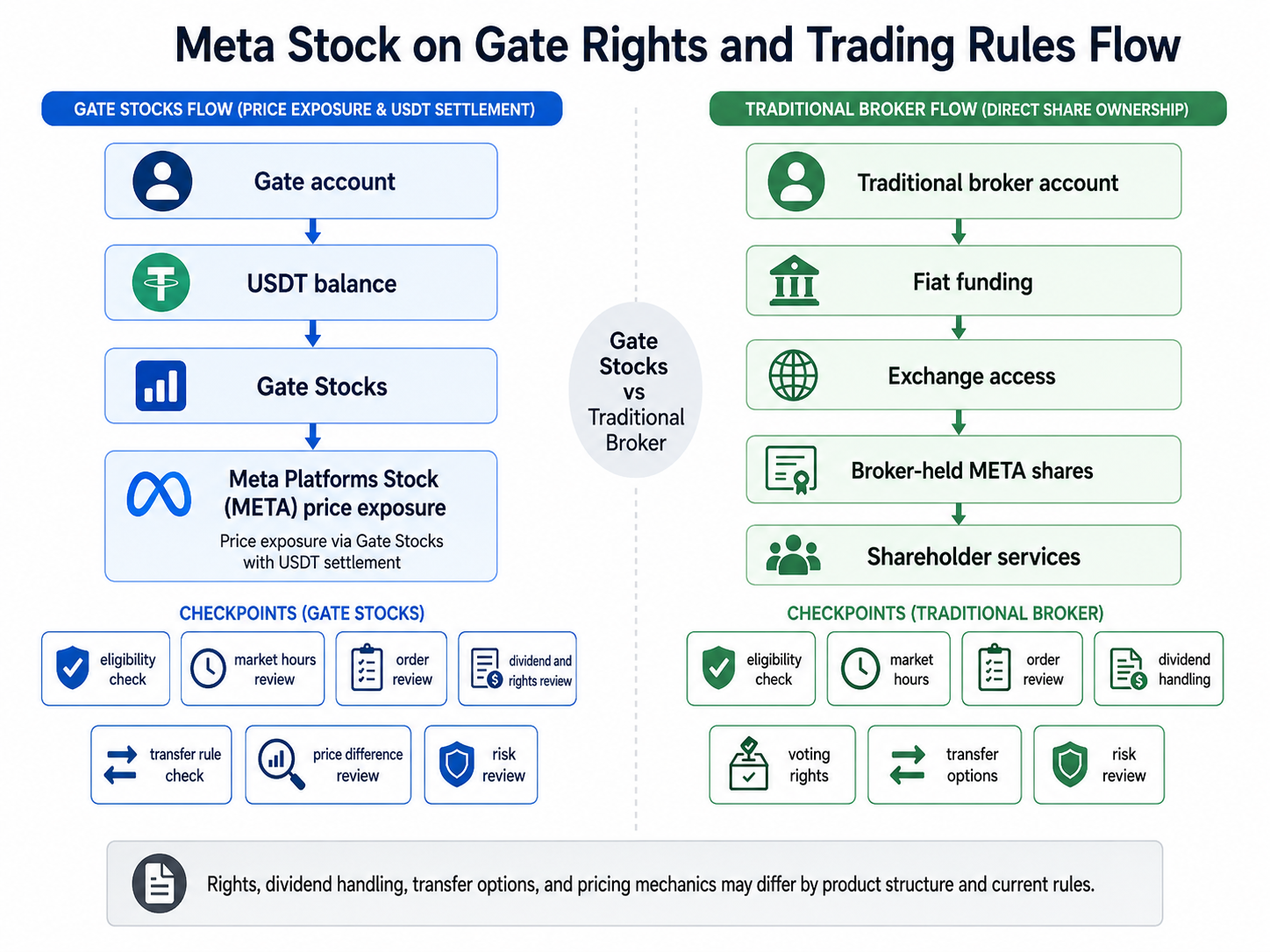
The key difference is the access structure. Buying Meta stock on Gate means accessing Meta Platforms Stock (META) through Gate Stocks, where eligible users can use USDT and follow Gate’s product rules. Buying through a traditional broker usually means opening a securities account, funding it with fiat currency, and accessing the market through the broker’s custody, clearing, reporting, and shareholder-service framework.
As of June 2026, Gate Learn describes Gate Stocks as a service that allows users to trade U.S. stocks and ETFs with USDT, without opening a separate overseas brokerage account. Gate’s related materials also describe access to more than 10,000 U.S. stocks and ETFs across major U.S. venues such as NYSE, Nasdaq, NYSE Arca, NYSE American, and BATS. This gives Gate Stocks a different user journey from the traditional broker model, where users usually deposit fiat currency, wait for bank or broker funding processes, trade through a securities account, and receive broker-generated custody and tax records.
The practical comparison becomes clearer when users separate live trading data from fixed product rules. For example, U.S. stock market settlement moved to T+1 in May 2024, meaning most applicable U.S. securities transactions through traditional market infrastructure settle one business day after the trade date. By contrast, Gate Stocks users should check Gate’s own account-record update, fund availability, corporate action, and withdrawal rules because the user-facing product flow is managed inside Gate’s account system. Similarly, a traditional broker may show a live bid and ask spread based on market quotes, while Gate Stocks users should review the live order page because Gate does not publish one universal fixed “typical spread” for every stock, time, and market condition.
Meta-specific dividend history also illustrates why the rights model matters. Meta initiated a quarterly cash dividend in 2024 at $0.50 per share, and Meta declared a $0.525 quarterly cash dividend in May 2026. A traditional broker would normally process such dividends through the user’s brokerage account if the user is eligible on the record date. Gate Stocks users should verify how supported Meta-related dividend events are reflected in Gate account records according to the latest Gate Stocks product rules as of June 2026.
| Comparison point |
Buying Meta stock on Gate |
Buying META through a traditional broker |
| Funding route |
USDT-based stock account flow through Gate Stocks |
Fiat deposit, bank transfer, or broker cash balance |
| Supported universe context |
Gate materials describe more than 10,000 U.S. stocks and ETFs as of June 2026 |
Depends on the broker’s market access and account type |
| Market access |
Gate Stocks connects to U.S. securities market access through its product structure |
Direct brokerage access to U.S. market infrastructure |
| Settlement reference |
User records and fund availability follow Gate Stocks product rules |
Applicable U.S. securities generally follow T+1 market settlement |
| Spread visibility |
Live Gate order page should be checked before confirmation |
Live bid and ask quotes are usually shown through broker systems |
| Typical spread note |
No universal fixed META spread should be assumed as of June 2026 |
Liquid U.S. stocks may show narrow spreads, but spreads vary by time and liquidity |
| Dividend example |
Supported dividend handling should be checked in Gate records |
Meta dividends such as $0.50 in 2024 and $0.525 in May 2026 are usually processed by brokers for eligible holders |
| Regional eligibility |
Must be checked through Gate account access and local rules |
Depends on broker onboarding, country support, and securities regulations |
| Voting and governance |
May not match registered shareholder voting rights |
May be available depending on broker and shareholding structure |
| Transfer options |
Should not be assumed transferable to external brokers |
Broker-to-broker transfer may be supported depending on market and broker |
Gate Stocks is designed around stock price exposure in a crypto-native account environment. Users do not need to treat it as identical to a traditional brokerage account, because the funding asset, account path, rights structure, transfer options, and corporate action handling may differ. A traditional broker may provide direct securities account statements, formal custody arrangements, voting participation, tax documents, and transfer tools depending on the broker and the user’s jurisdiction.
For users who want a broader foundation, the mechanics of Gate Stocks trading explain how U.S. stock and ETF access can be connected with USDT-based account management. The operational tutorial for buying Meta stock with USDT on Gate covers the step-by-step purchase flow, while this article focuses on rights, limitations, and trading rules.
| Preparation item |
What to check before buying Meta stock on Gate |
Why it matters |
| Stock name and ticker |
Meta Platforms Stock (META) |
Avoids selecting the wrong asset |
| Product type |
Gate Stocks price exposure |
Confirms the position follows Gate Stocks rules |
| Settlement asset |
USDT, if used in the Gate Stocks flow |
Funding and accounting may differ from fiat brokerage accounts |
| Dividend rule verification |
Latest Gate Stocks rules as of June 2026 |
Dividend treatment may differ from direct shareholding |
| Voting rights verification |
Latest Gate Stocks rights rules as of June 2026 |
Governance rights may not match broker-held shares |
| Transfer rule verification |
Latest transfer rules as of June 2026 |
Positions should not be assumed transferable to a broker |
| Regional eligibility |
User account and jurisdiction status |
Access may vary by region and compliance requirements |
| Risk review |
Market, product, liquidity, USDT, and platform risks |
Prevents treating the product as risk-free or identical to a broker |
These preparation points matter because the order screen is only one part of the decision process. Users should also understand the account structure, product-rule dependency, live spread review, settlement path, dividend record handling, and rights framework before comparing Gate Stocks with a traditional broker.
Dividend handling for users holding Meta stock on Gate should be verified from Gate’s latest official product rules before trading, as of June 2026. Gate Stocks may process supported corporate actions according to product rules, but users should not assume that dividend handling is identical to a traditional brokerage account.
In a traditional brokerage structure, cash dividends are usually processed through the broker and reflected in the user’s securities account or linked cash account. In Gate Stocks, dividend-related treatment may follow a digital asset account framework, and cash-based benefits may be reflected differently depending on the product design, user eligibility, corporate action type, processing timing, and settlement rules. The key point is that dividend visibility and entitlement should be checked through the user’s own Gate account records and the latest Gate Stocks documentation.
Meta is a useful example because it has recent dividend history. Meta initiated a quarterly dividend in 2024 at $0.50 per share, and it declared a $0.525 quarterly cash dividend in May 2026, payable in June 2026 to stockholders of record on the stated record date. For a traditional brokerage account, the broker would normally process such payments for eligible holders. For Gate Stocks, users should review whether the relevant corporate action is supported, how account records display the dividend, what timing applies, and whether any product-specific adjustment or processing rule applies as of June 2026.
Users comparing economic participation and shareholder status can review Gate Stocks economic rights and shareholder rights to understand why economic benefits and governance rights are separate topics. A dividend is an economic benefit, while voting at a shareholder meeting is a governance right. These two categories should not be mixed.
Users holding Meta stock on Gate should not assume they have the same shareholder voting rights as users holding META through a traditional broker. Voting rights may not be the same as holding shares directly through a traditional broker, and users should refer to Gate’s latest product rules for the current rights structure as of June 2026.
The reason is that economic exposure and registered shareholder participation are not always the same thing. A user may have exposure to the price movement of Meta Platforms Stock (META) and may receive supported economic benefits according to product rules, but that does not automatically mean the user is recorded as a registered shareholder in the same way as a direct brokerage framework. Traditional brokers may support voting instructions for shareholder meetings, proxy proposals, and certain corporate actions, depending on the broker, market, security, and jurisdiction.
This distinction matters for users who care about corporate governance. Meta Platforms, Inc. has shareholder voting processes like other public companies, but access to those voting processes depends on how the user holds the exposure. Gate Stocks should be reviewed as a product structure with its own rights model.
A practical rule is to separate three questions: Can the user gain price exposure to META? How are supported economic events handled? Are governance rights such as shareholder voting available? Each question may have a different answer under Gate Stocks rules as of June 2026.
The displayed price for Meta stock on Gate may differ from a reference exchange price because order execution depends on product structure, liquidity, timing, spreads, market access, trading hours, and quote sources. A price shown before confirmation should be treated as an estimate or reference point unless the order page clearly confirms the final execution details.
Gate Stocks connects users with stock market exposure through a product interface, but the final order result can be affected by market movement. U.S. stocks trade during defined market sessions, and price formation is influenced by supply, demand, market depth, and available liquidity. If a user submits an order during a fast-moving period, the final filled price may not match the last displayed quote. If a market is closed, the order may not immediately execute, or it may follow the rules shown in the product interface.
Spreads can also matter. A buy quote and a sell quote may differ, especially during volatile conditions or when liquidity is thinner. Gate does not publish one fixed “typical spread” for every Gate Stocks product as of June 2026, so users should review the live bid, live ask, estimated cost, quantity, fees, and final confirmation screen before placing an order. The final confirmation screen is the most important checkpoint because it reflects the current order context as of that moment.
A careful user should not treat price differences as guaranteed arbitrage or manipulation. Price differences can arise from normal execution mechanics, timing, product design, and market conditions. The correct response is to review the order page, understand the order type, and confirm only when the displayed details are clear.
Users should not assume that positions held through Gate Stocks can be transferred to an external brokerage account unless Gate’s official product rules clearly support such transfers as of June 2026. This is one of the most important differences between a product-based stock exposure service and a traditional brokerage account.
In a traditional brokerage environment, users may have access to securities transfer systems, broker-to-broker transfer processes, or custody movement options, depending on the market and broker. These processes are tied to securities account infrastructure. Gate Stocks, by contrast, should be understood through the product rules that apply inside Gate’s account system. A user may be able to buy, hold, and sell exposure through Gate Stocks, but that does not automatically mean the position can be moved into an outside brokerage account.
This matters for users who may later want consolidated custody, external tax reporting, long-term brokerage statements, estate planning tools, or voting services through a traditional broker. Before buying Meta stock on Gate, users should check whether external transfer is supported, whether only internal account records are available, and whether selling the position is the practical exit route.
The comparison between Gate Stocks, traditional brokers, and stock CFDs is useful because it separates product structures that can look similar from a price chart perspective but differ in ownership, rights, transferability, and reporting.
Buying Meta stock on Gate may be more suitable for eligible users who already hold USDT, want access to Meta Platforms Stock (META) exposure through Gate Stocks, prefer a crypto-native account environment, and want a simplified product flow inside an existing Gate account. This does not mean Gate is better than a broker. It means the structure may fit users whose main need is price exposure through USDT-based account management.
A traditional broker may be more suitable for users who need full brokerage services. These may include direct exchange-based share custody, formal securities statements, shareholder voting participation, broker-provided tax documents, portfolio reporting tools, transfer options, margin services, and broader securities account support. Users who require these features should check whether Gate Stocks provides equivalent functions before assuming it fits their needs.
The decision should start with the user’s objective. If the goal is to access META exposure using USDT in a crypto-native environment, Gate Stocks may be relevant. If the goal is long-term registered shareholding, shareholder voting, broker statements, tax documentation, and transfer flexibility, a traditional broker may be more aligned.
The broader process for buying U.S. stocks with USDT on Gate can help users understand the funding and order review flow. Users who specifically want to avoid a separate brokerage onboarding path may also compare USDT stock trading on Gate without a brokerage account with the services they would otherwise expect from a securities broker.
| Dimension |
Buying Meta stock on Gate |
Buying META through a traditional broker |
| Access method |
Gate account and Gate Stocks eligibility |
Securities brokerage account |
| Price exposure |
Exposure to Meta Platforms Stock (META) through Gate Stocks |
Broker-based exposure to listed META shares |
| Settlement asset |
USDT, where supported |
Usually fiat currency such as USD |
| Dividend handling |
According to Gate Stocks product rules as of June 2026 |
According to broker and market rules |
| Voting rights |
May not match registered shareholder voting rights |
May be available depending on broker and holding structure |
| Transfer options |
Must be verified in Gate product rules |
May support broker-to-broker transfers |
| Trading hours |
Subject to Gate Stocks and U.S. market rules |
Subject to broker and market session rules |
| Statements and reporting |
Gate account records and product history |
Broker statements, tax forms, and custody records |
| Product-rule dependency |
High, because the rights model follows Gate Stocks terms |
Broker rules plus market and custody rules |
| Risk profile |
Market risk plus product, USDT, platform, and eligibility risks |
Market risk plus broker, custody, fee, and jurisdiction risks |
The comparison shows that the two routes are not simply different interfaces for the same user experience. They may differ in funding, rights, account records, transfer flexibility, settlement references, spread visibility, and practical responsibilities.
Buying Meta stock on Gate involves several layers of risk. Market risk comes first. Meta Platforms Stock (META) can rise or fall because of earnings results, digital advertising conditions, AI infrastructure spending, regulatory scrutiny, platform competition, macroeconomic conditions, interest rates, and broader equity market sentiment. Past performance does not indicate future results.
Stock-specific risk also matters. Meta’s business depends on user engagement, advertising demand, product execution, privacy rules, content policy pressure, infrastructure investment, and competition across social media, messaging, AI, and immersive technology. These factors can affect investor expectations and market pricing.
Product-structure risk is separate from stock risk. Gate Stocks follows its own product rules for settlement, account records, corporate actions, dividends, voting rights, transfer options, trading access, and eligibility. Users should check the latest Gate Stocks documentation as of June 2026 before trading.
Liquidity and price difference risk can affect order execution. A displayed quote may differ from a final fill price due to timing, spread, market depth, order type, or volatility. Platform risk also exists because users depend on Gate account access, system availability, internal records, and product operations.
Regulatory and regional eligibility risk should not be ignored. Gate Stocks availability may vary by jurisdiction, compliance status, product updates, and account type as of June 2026. Stablecoin-related risk also applies when USDT is used for settlement, since USDT may involve issuer, liquidity, market price, redemption, and regulatory considerations.
Dividend and rights interpretation risk is especially important. Users should not assume that all shareholder rights available through a traditional broker apply to Gate Stocks. Transfer limitation risk also matters because positions should not be assumed transferable to external brokers unless current Gate rules clearly support that function.
Summary
Buying Meta stock on Gate gives eligible users a way to access Meta Platforms Stock (META) price exposure through Gate Stocks and USDT settlement, as of June 2026. The main benefit is not a promise of better returns, but a different account and funding structure for users already operating in a digital asset environment.
The important distinction is that Gate Stocks and traditional broker-held shares may differ in rights, dividend processing, voting participation, transfer options, account records, reporting, settlement references, spread visibility, and eligibility. Users should review the latest product rules, order page details, fees, market status, and risk notices before placing any order.
A traditional broker may remain more suitable for users who need full securities account services, direct shareholder participation, formal brokerage reporting, and transfer flexibility. Gate Stocks may be more relevant for users who want USDT-based access to stock price exposure through a crypto-native account structure.
Stock investing involves market risk, and prices may fluctuate significantly. Please make decisions carefully based on your own risk tolerance. This article does not constitute investment advice.
FAQs
Buying Meta stock on Gate gives users price exposure to Meta Platforms Stock (META) through Gate Stocks. Users should not automatically treat the position as identical to holding directly registered or broker-held shares, because shareholder rights, transfer rules, settlement references, and account records may differ as of June 2026.
Meta stock on Gate may be held according to Gate Stocks product rules, account eligibility, and supported market access as of June 2026. Users considering long-term holding should review dividend treatment, rights structure, account records, transfer limitations, platform risk, and regional availability.
Dividends for Meta stock on Gate should be verified from the latest Gate Stocks product rules as of June 2026. Meta has paid quarterly dividends since 2024, but Gate Stocks users should check whether supported dividend events are reflected in their Gate account records and under what processing rules.
Voting rights for Meta stock on Gate may not be the same as holding META through a traditional broker. Users should check Gate’s latest rights structure as of June 2026, especially if shareholder meeting participation or proxy voting is important to them.
Meta stock positions held through Gate Stocks should not be assumed transferable to an external broker unless Gate’s current product rules clearly support such transfers as of June 2026. Users who need broker-to-broker transfer flexibility should verify this before trading.
Meta stock prices on Gate may differ from exchange references because of timing, liquidity, spreads, order type, trading hours, product structure, and market movement. Users should review the final order page before confirming any trade.







