Gate Stocks is designed for users who want access to selected U.S. stocks and ETFs through a Gate account using USDT settlement. For Google Stock, users should confirm that the correct listing is Alphabet Inc. Class A Common Stock (GOOGL), since Google’s parent company is Alphabet.
What Do You Need Before Buying Google Stock on Gate?
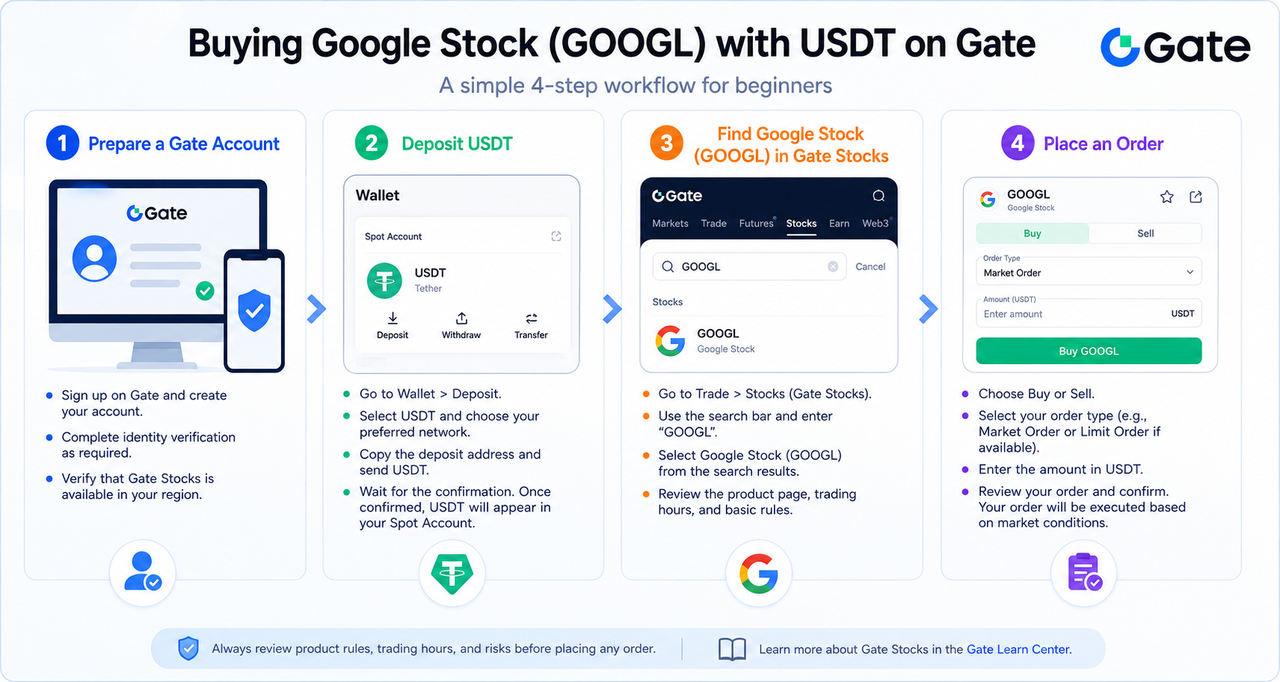
Before buying Google Stock with USDT, users need a Gate account, access to Gate Stocks, and a sufficient USDT balance. Identity verification may be required depending on account status, product access rules, and regional eligibility (As of June 2026).
Users should also check whether Gate Stocks is available in their region. U.S. stock access, account requirements, and product rules may differ by jurisdiction, so eligibility should be confirmed through official Gate sources before placing an order (As of June 2026).
A useful starting point is understanding how U.S. stock trading with USDT works inside Gate. Users who are new to the product can also review what Gate Stocks trading means before moving funds.
| Requirement |
Why It Matters |
User Check |
| Gate account |
Required to access Gate products |
Confirm account access and security settings |
| Identity verification |
May be needed for Gate Stocks access |
Complete required verification if prompted |
| USDT balance |
Used for stock settlement on Gate Stocks |
Confirm available USDT before ordering |
| Product availability |
Google Stock access may depend on Gate rules |
Verify Google Stock (GOOGL) is available |
| Regional eligibility |
Stock access may vary by location |
Check official Gate access rules |
This table helps users separate account preparation from trading decisions. The most important step is to confirm current product access before placing an order, especially because stock availability and regional rules can change (As of June 2026).
Step 1: How to Deposit USDT on Gate
To buy Google Stock with USDT, users first need USDT in their Gate account. Gate may support different funding routes, such as on-chain deposits or other available account funding options, depending on the user’s region and account status (As of June 2026).
When depositing USDT on-chain, users should select the correct network, copy the correct Gate deposit address, and send only supported assets to that address. Sending USDT through the wrong network or sending an unsupported asset may result in loss of funds.
After the transfer is submitted, users should check the deposit status in their Gate account. Funds may require network confirmations before becoming available. Once the USDT balance is credited, users may need to ensure it is available for Gate Stocks trading according to current account rules (As of June 2026).
Users who want broader context on crypto-funded market access can review how crypto assets can connect with traditional market products, while keeping in mind that stock trading rules are separate from commodity-related examples.
Step 2: How to Find Google Stock on Gate
After funding the account, users can go to the Gate Stocks section and search for Google Stock by ticker. The relevant listing should be checked carefully because Google’s parent company is Alphabet, and the Class A share ticker is GOOGL.
Users should confirm the asset name, ticker, market status, order rules, minimum purchase amount, and any product notices before placing an order (As of June 2026). Gate’s Stocks section shows selected stock and ETF assets, but users should always rely on the live Gate interface for final confirmation.
A simple verification flow is useful before any order:
| Step |
User Action |
Key Check |
| 1 |
Open Gate Stocks |
Confirm the correct Gate Stocks section |
| 2 |
Search GOOGL |
Match Google Stock with Alphabet Inc. Class A Common Stock |
| 3 |
Review product page |
Check availability, market status, and rules |
| 4 |
Check balance |
Confirm sufficient USDT |
| 5 |
Review order screen |
Confirm quantity, cost, and fees before submission |
The goal is to avoid choosing the wrong asset or misunderstanding the product rules. For users comparing Gate Stocks with other access models, Gate Stocks vs brokers vs stock CFDs can help explain important differences in structure and user experience.
Step 3: How to Place an Order for Google Stock
To place an order for Google Stock, users should open the Google Stock (GOOGL) trading page inside Gate Stocks, enter the intended purchase amount or share quantity, and review the order details before confirming.
If market orders are supported, the order may execute based on available market pricing and liquidity (As of June 2026). If limit orders are supported, users may set a maximum purchase price, but execution is not guaranteed unless market conditions meet the order terms (As of June 2026). Users should confirm supported order types in the live Gate interface before submitting any order.
Before confirming, users should review:
-
Google Stock (GOOGL) asset name and ticker
-
Order type
-
Quantity or fractional share amount
-
Estimated USDT cost
-
Estimated fee
-
Market status and liquidity
-
Any product notices or restrictions
Once the order is submitted, execution depends on the order type, market status, and available liquidity. After execution, users can review the position in their Gate Stocks account area.
Users considering stock spot exposure alongside derivative products should understand the difference between direct stock access and contract trading. The comparison of U.S. stock spot vs futures on Gate explains why spot-style access and leveraged contracts carry different mechanics and risks.
What Are the Trading Fees for Google Stock on Gate? (As of June 2026)
Gate lists stock trading fees starting from 0.023% on the Gate Stocks page (As of June 2026). Users should verify the current fee schedule through official Gate sources before placing an order (As of June 2026).
Fees may vary depending on product rules, account status, order conditions, market access arrangements, or future changes to Gate’s stock trading schedule (As of June 2026). Users should also consider spreads, execution price differences, and any other applicable costs shown before order confirmation (As of June 2026).
| Fee or Cost Type |
Meaning |
Verification Requirement |
| Trading fee |
Fee charged for executing a stock order |
Verify current rate before trading (As of June 2026) |
| Spread |
Difference between buy and sell pricing |
Check live quote conditions before placing an order |
| Execution cost |
Final fill may differ from estimate depending on order type |
Review confirmation screen carefully |
| Custody or account maintenance fees |
Any custody, holding, or account-related charge if applicable |
Verify current Gate fee rules before trading (As of June 2026) |
| Other applicable costs |
Product rules may change over time |
Use official Gate sources for current details |
This fee table should be treated as a checklist, not a fixed cost schedule. The final order screen and current Gate fee information should be reviewed before buying Google Stock with USDT (As of June 2026).
Users comparing costs with traditional access models can review Gate U.S. stock trading commission vs traditional brokers, while still confirming live fees inside Gate before placing an order.
What Risks Should You Understand Before Buying Google Stock?
Buying Google Stock with USDT involves market risk. Google Stock (GOOGL) may rise or fall due to company performance, broader technology sector conditions, interest rates, economic data, earnings results, regulatory developments, and overall market sentiment.
Users should also understand stock-specific risk. Alphabet’s business includes search, advertising, cloud services, YouTube, artificial intelligence initiatives, and other areas, and changes in any major segment may affect the stock price. Past performance does not guarantee future results.
Liquidity risk may also apply. Even when a stock is widely traded in traditional markets, execution conditions inside a specific product interface can depend on market hours, routing, product rules, order type, and available liquidity (As of June 2026).
Product-rule risk is important. Users should review how Gate Stocks handles economic rights, corporate actions, dividends, splits, reverse splits, and shareholder-related limitations. For more context, users can read about Gate Stocks economic rights and shareholder rights.
Users should also consider platform risk, settlement risk, regulatory risk, and USDT-related considerations. Since the position is accessed through Gate Stocks and settled with USDT, users should understand both the stock market component and the digital asset settlement component.
Summary
Buying Google Stock with USDT on Gate involves a practical sequence: prepare a Gate account, complete required verification if applicable, deposit USDT, open Gate Stocks, search for Google Stock (GOOGL), review product rules, and confirm the order details before trading.
The key user checks are product availability, regional eligibility, current fees, supported order types, corporate action rules, and execution conditions (As of June 2026). Gate Stocks may make it easier for crypto users to connect USDT balances with selected U.S. stock access, but the product still carries market, platform, liquidity, regulatory, and settlement risks.
FAQs
Can I buy Google Stock with USDT on Gate?
Yes, users can buy Google Stock with USDT on Gate through Gate Stocks if Google Stock (GOOGL) is available to their account and region (As of June 2026). Users should verify current product availability inside the official Gate interface before placing an order.
Is the Google Stock purchased on Gate the same as buying through a traditional broker?
Google Stock on Gate is accessed through Gate Stocks using USDT settlement, while traditional brokers usually use fiat settlement and conventional brokerage account structures. Users should compare account rules, rights, fees, settlement, and product mechanics before trading (As of June 2026).
What ticker should I search to buy Google Stock with USDT?
To buy Google Stock with USDT, users should search for GOOGL and confirm that the listing refers to Alphabet Inc. Class A Common Stock. Users should always check the asset name and ticker before submitting any order.
What is the minimum amount required to buy Google Stock on Gate?
Google Stock minimum purchase requirements should be verified in the live Gate Stocks interface before ordering (As of June 2026). Gate’s Stocks page references fractional share access, but users should confirm the current minimum order rule for Google Stock (GOOGL) before trading.
Are dividends available when holding Google Stock on Gate?
Google Stock dividend and corporate action handling should be verified through official Gate rules before placing an order (As of June 2026). Gate Stocks states that cash dividends, stock dividends, splits, and reverse splits are handled according to product rules, so users should review those rules carefully.
Does Gate charge custody or account maintenance fees for Google Stock?
Users should verify whether any custody, account maintenance, or other applicable fees apply to Google Stock through official Gate sources before placing an order (As of June 2026). Fee rules may change, so the live Gate Stocks interface and current fee schedule should be checked before trading.
Can I sell my Google Stock position on Gate?
Users may sell Google Stock on Gate if selling is available under current Gate Stocks rules, market status, account eligibility, and regional access conditions (As of June 2026). The live order screen should be checked for available order types, estimated proceeds, fees, and execution conditions.
Stock investing involves market risk, and prices may fluctuate significantly. Please make decisions carefully based on your own risk tolerance. This article does not constitute investment advice.







