Bitcoin Price Prediction BTC Faces New Liquidity Cycle With Potential Moves Between 78000 And 89000

Last Updated 2026-03-26 20:27:15
Reading Time: 1m
Following a correction exceeding 30%, Bitcoin's volatility has settled. The main phase of selling is structurally complete. Heavy selling from long-term holders has reduced the circulating supply to its lowest point since March, laying the groundwork for a possible supply squeeze in the next market cycle.

Short-Term Crypto Market Volatility Overview

Bitcoin has shown apparent stability after weeks of turbulence, but underlying shifts are quietly taking shape. Its price recently corrected more than 30% from all-time highs. While this drop is notable, it aligns with typical bull market cycles. During the downturn, long-term holders offloaded large volumes, pushing circulating supply to its lowest level since March. With the main selling phase now past, the market is turning its attention to upcoming supply trends.

Bitcoin’s price has also entered the $88K - $89K range, a zone formed by a previous rapid rally that left a price gap. Retail investor activity has cooled noticeably, and the broader market remains in a holding pattern.

Key Policy Watch: Federal Reserve and Bank of Japan

The Federal Reserve’s interest rate decision is set to be the most significant short-term market catalyst. While most expect a 25 basis point cut, investors are focused on the policy statement’s tone and forward guidance. With thin order books and reduced volatility, even a single comment could spark sharp moves in Bitcoin’s price.

The Bank of Japan is also drawing attention. After years of negative rates, Japan may hike again, potentially attracting capital flows back to Japan, lifting U.S. yields, and tightening global liquidity. Such actions typically weigh on risk assets—including cryptocurrencies.

Regulatory Acceleration

U.S. SEC Chairman Paul Atkins recently announced that the Bitcoin Market Structure Bill is nearing passage, signaling consensus between Congress and regulators on crypto oversight. The bill will establish rules for spot Bitcoin ETFs, clarify SEC and CFTC regulatory responsibilities, and set baseline standards for crypto exchange operations.

BlackRock has filed for a new staked ETH ETF. MicroStrategy acquired 10,624 BTC following talks with banks and sovereign funds. Meanwhile, Argentina’s central bank is considering allowing banks to offer Bitcoin services.

Technical Price Outlook

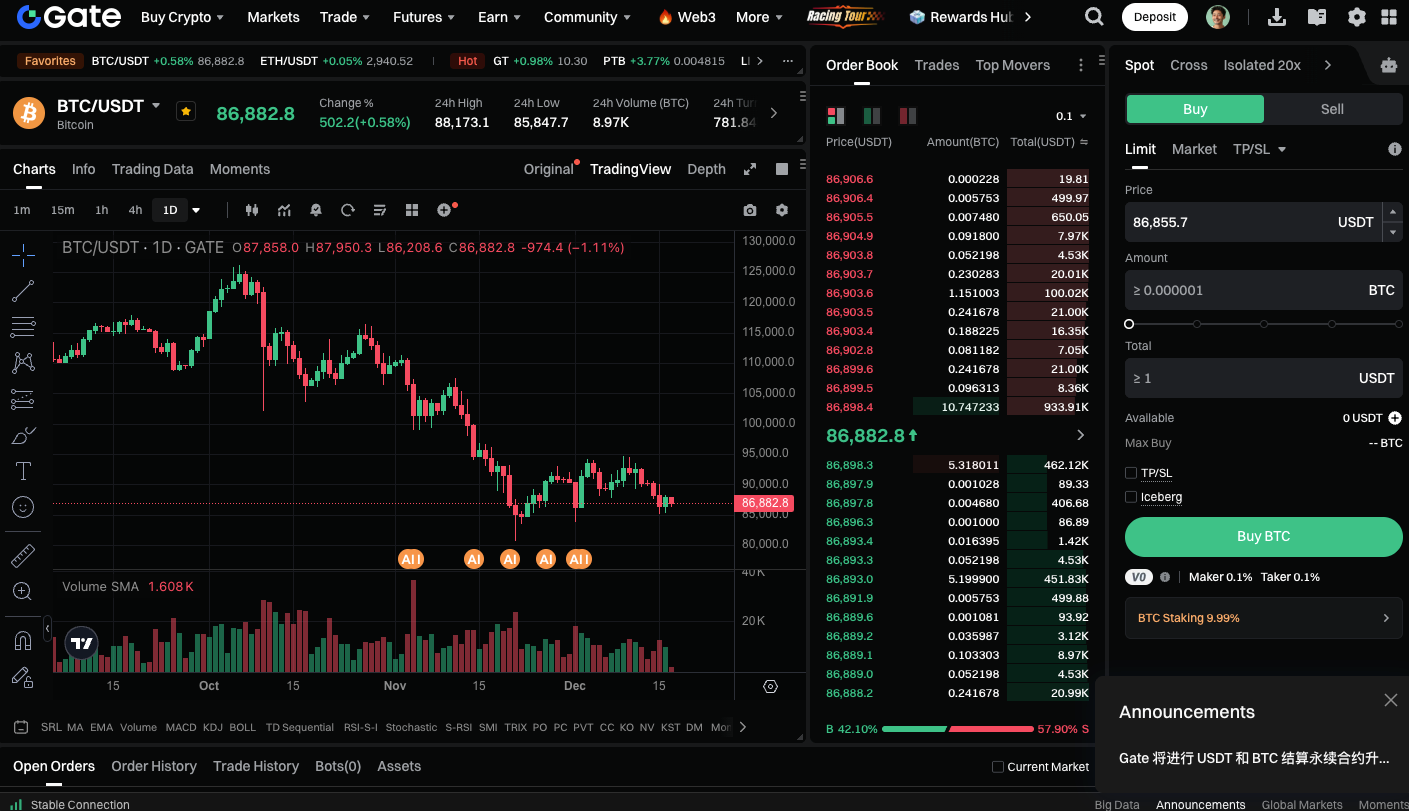
In the near term, Bitcoin could rise on liquidity flows. If the Fed adopts a dovish stance, prices may test the $88K - $89K zone. If the tone is more hawkish, the market could pull back to $78K - $82K. Investors should closely track policy statements, liquidity conditions, and trading volume to gauge the next market direction.

Start trading BTC spot now: https://www.gate.com/trade/BTC_USDT
Conclusion

Bitcoin’s recent stability masks significant liquidity changes beneath the surface. The major selloff has ended, supply is tightening, and policy and regulatory shifts will drive short-term price action. Investors should monitor the tone of decisions from the Federal Reserve and Bank of Japan, institutional positioning, and trading volumes to assess whether Bitcoin can break through the $88K - $89K resistance or fall back to the $78K - $82K support zone. Ultimately, a shift in the liquidity cycle could set the pace for the next phase of the market, giving informed investors an edge in the coming moves.

Author: Allen
Disclaimer
* The information is not intended to be and does not constitute financial advice or any other recommendation of any sort offered or endorsed by Gate.
* This article may not be reproduced, transmitted or copied without referencing Gate. Contravention is an infringement of Copyright Act and may be subject to legal action.

Related Articles

AI-Native Settlement Layers: How United Stables Is Building the Next Financial Rail
Beginner

AI-Native Settlement Layers: How United Stables Is Building the Next Financial Rail

Stablecoins were originally designed as dollar substitutes within exchanges, primarily used for asset pricing and trade settlement. As on-chain financial ecosystems have matured, their role has expanded beyond simple payments to include collateral assets, cross-chain liquidity mediums, and unified settlement units. In particular, as AI systems and automated agents begin to participate directly in economic activity, demand has risen sharply for programmable value units capable of instant settlement. This shift is pushing stablecoins toward the role of foundational financial infrastructure.
2026-03-25 03:16:17
The ve(3,3) Flywheel Explained: How AERO Tokenomics Powers Aerodrome’s DeFi Economy
Beginner

The ve(3,3) Flywheel Explained: How AERO Tokenomics Powers Aerodrome’s DeFi Economy

In the competition for DeFi liquidity, high-inflation mining alone is no longer enough to build lasting advantages. Aerodrome applies the ve(3,3) economic model to redesign token emissions, voting mechanisms, and revenue distribution, creating a liquidity flywheel centered on governance and cash flow. This article examines AERO tokenomics, the veAERO locking mechanism, and protocol revenue models to explain how Aerodrome builds a sustainable DeFi economic system.
2026-03-25 06:41:58
Aerodrome Tokenomics: How ve(3,3) Powers Base's Most Profitable DEX
Beginner

Aerodrome Tokenomics: How ve(3,3) Powers Base's Most Profitable DEX

AERO is the native token of Aerodrome Finance, a core decentralized exchange and liquidity protocol in the Base ecosystem. It is primarily used for liquidity incentives and ecosystem operations. veAERO is a governance NFT that users receive by locking AERO, representing both voting power and the right to share protocol revenue. Through a dual track structure of AERO as a utility token and veAERO as a governance credential, Aerodrome separates liquidity usage value from long term governance power, allowing participants to act as liquidity providers, governance decision makers, and revenue sharers within the same system.
2026-03-25 06:40:31
How Does PAXG Work? In-Depth Overview of the Physical Gold Tokenization Mechanism
Beginner

How Does PAXG Work? In-Depth Overview of the Physical Gold Tokenization Mechanism

PAXG (Pax Gold) is a tokenized asset backed by physical gold, issued by the fintech company Paxos and traded on the Ethereum blockchain as an ERC-20 token. The core concept is to tokenize physical gold on-chain, with each PAXG token representing ownership of a certain amount of gold. This structure enables investors to hold and trade gold in the form of a digital asset.
2026-03-24 19:12:51
How is the price of PAXG determined? Pegging mechanism, trading depth, and influencing factors
Beginner

How is the price of PAXG determined? Pegging mechanism, trading depth, and influencing factors

PAXG (Pax Gold) is a tokenized asset backed by physical gold reserves, launched by fintech firm Paxos and issued as an ERC-20 token on the Ethereum blockchain. The core concept is to digitally represent real-world gold assets, allowing investors to hold and trade gold via the blockchain network. Because each PAXG token corresponds to a specific quantity of physical gold, its price is theoretically expected to closely track the global gold market.
2026-03-24 19:11:40
DePIN Identity Network and Real World Applications: How Humanity Protocol Brings on-chain Identity Into the Physical World
Beginner

DePIN Identity Network and Real World Applications: How Humanity Protocol Brings on-chain Identity Into the Physical World

Most Web3 identity systems remain confined to on-chain environments and struggle to achieve meaningful adoption in real world settings. Through a DePIN architecture and physical verification hardware, Humanity Protocol aims to bring decentralized identity into access control systems, hospitality, public services, and offline events, allowing on-chain identity to function not just as a digital credential, but as foundational infrastructure for real world access.
2026-03-25 07:40:53





