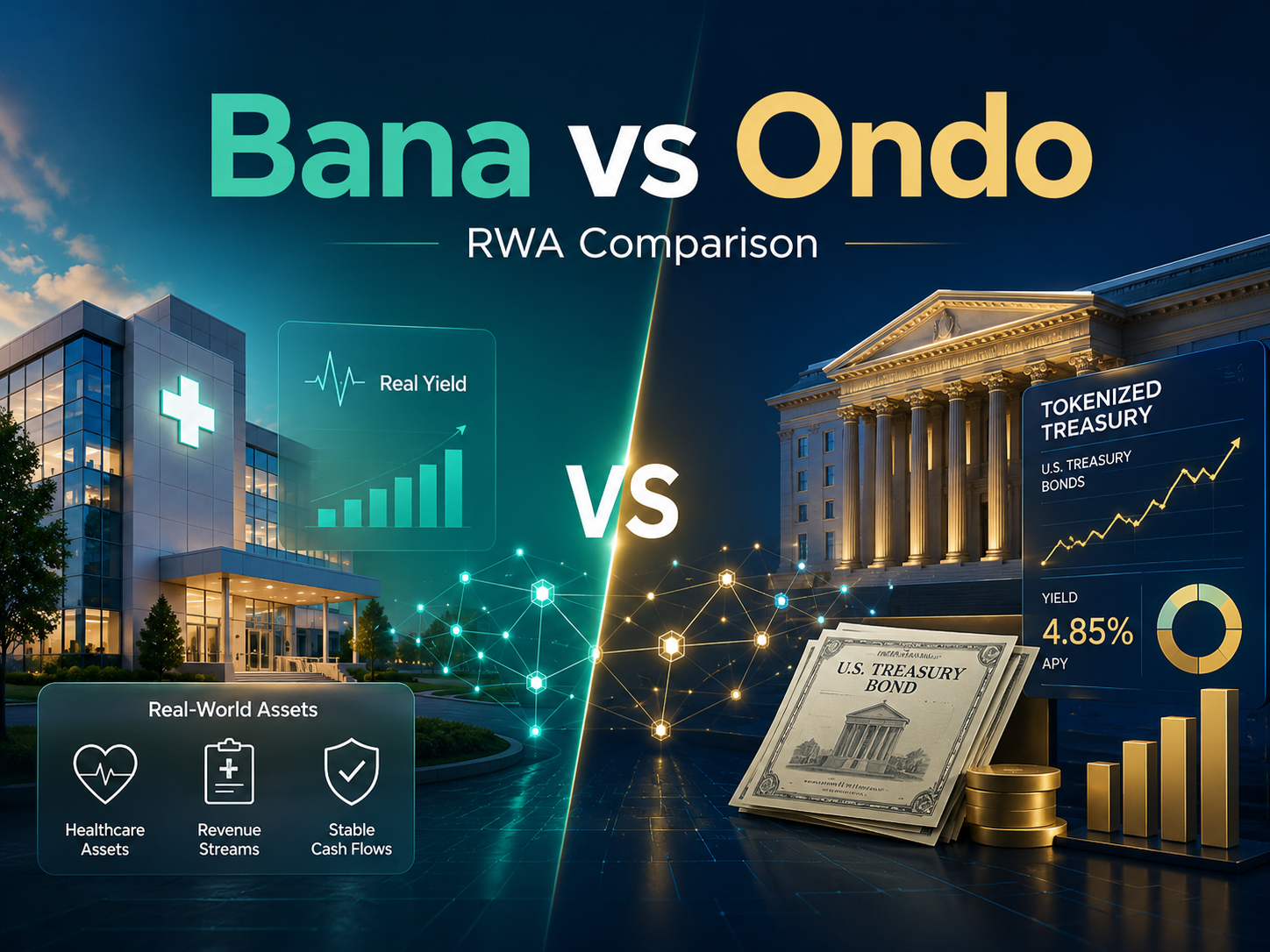
The primary issue for RWA protocols isn’t simply “whether to go on-chain,” but rather “which assets are tokenized, where the yield originates, and what types of on-chain assets users actually receive.” Bana Protocol puts a strong focus on Real Business, Real Yield, and Buyback & Burn, aiming to anchor ecosystem value with real-world business cash flows. In contrast, Ondo Finance functions more as on-chain institutional financial infrastructure, offering tokenized financial asset access through products like OUSG and USDY. Ondo’s official website describes the platform as bringing institutional-grade finance on-chain, highlighting products such as OUSG, USDY, and Ondo Global Markets.
From a search intent perspective, Bana Protocol and Ondo Finance differ mainly across five dimensions: underlying asset structure, yield sources, token mechanisms, target users, and application scenarios. Understanding these distinctions helps clarify the two main RWA pathways: “commercial income RWA” versus “financial asset RWA.”
What Is Bana Protocol
Bana Protocol is an RWA protocol grounded in real-world assets, with a narrative centered on the medical industry, real business yield, hybrid custody, and buyback & burn. Official sources emphasize Bana Protocol’s mission to connect real-world assets and build a growth model through mechanisms like buyback and burn.
Rather than simply tokenizing a single financial asset, Bana Protocol seeks to bring revenues from real-world businesses—such as medical services, medical aesthetics, and medical tourism—on-chain. The protocol aims to connect real-world business operations with the BANA Token’s value cycle through real yield, so the token’s value isn’t solely tied to on-chain trading demand.
Bana Protocol’s distinguishing feature is its asset sourcing from real business operations, not traditional financial assets. Revenue from medical centers, anti-aging services, and medical tourism is converted into on-chain value through profit distribution, buyback, and burn mechanisms.
What Is Ondo Finance
Ondo Finance is an RWA platform built around tokenized financial assets, with a focus on US Treasuries, money market funds, and on-chain institutional products. Ondo’s OUSG product is designed for qualified purchasers, providing exposure to short-term US Treasuries and money market funds, with subscription and redemption available via stablecoins.
USDY, Ondo Finance’s yield-bearing US dollar token, is backed by assets such as short-term US Treasuries, short-term bond ETF shares, or bank demand deposits, according to official documentation. It is available to eligible non-US individuals and institutions. USDY is offered in both accumulating and rebase (rUSDY) formats, each suited to different on-chain use cases.
Compared to Bana Protocol, Ondo Finance’s asset structure more closely mirrors traditional financial products brought on-chain. Its focus isn’t on medical or real-world commercial operations, but on delivering high-quality financial assets to qualified users through compliant structures, custodial arrangements, and tokenization.
How Do Their Underlying Asset Structures Differ?
The most significant distinction between Bana Protocol and Ondo Finance lies in their underlying asset structures. Bana Protocol is built around medical RWAs and, in the future, other real-world industries, emphasizing business operating income. Ondo Finance, by contrast, relies on US Treasuries, money market funds, and related financial assets, highlighting institutional-grade financial assets on-chain.
Bana Protocol’s underlying assets are “operational assets”—businesses like medical services, medical aesthetics, and medical tourism require ongoing real-world operations, and their yields depend on actual business performance. Their value is driven by service capabilities, customer demand, and business networks, not just the assets themselves.
Ondo Finance’s underlying assets are “financial assets.” OUSG offers exposure to short-term US Treasuries and money market funds, while USDY is linked to US dollar assets such as short-term US Treasuries, short-term bond ETF shares, or bank deposits. The core model is to transform traditional yield-bearing assets into on-chain products that can be held, transferred, or composed.
| Comparison Dimension |
Bana Protocol |
Ondo Finance |
| RWA Type |
Medical industry and multi-sector real assets |
US Treasuries, money market funds, US dollar yield assets |
| Asset Attribute |
Operational assets |
Financial assets |
| Yield Basis |
Medical services and business operating income |
Bond, fund, or US dollar asset yields |
| Core Asset Logic |
Real business generates real yield |
Tokenized financial assets provide on-chain exposure |
| Asset Expansion |
Medical, hospitality, real estate, AI, education, etc. |
OUSG, USDY, Ondo Global Markets, etc. |
This comparison shows that while both are RWAs, they are not at the same asset tier. Bana Protocol is akin to “bringing real business income on-chain,” whereas Ondo Finance is “bringing traditional financial products on-chain.”
How Do Their Yield Sources and Value Cycles Differ?
Bana Protocol’s yield is derived mainly from real-world business income, particularly cash flows from the medical industry and future multi-sector operations. The protocol aims to transform actual business revenue into real yield and feed part of this value back into the BANA Token cycle via buyback & burn.
Ondo Finance’s yield comes from underlying financial assets. For example, USDY is designed to combine the accessibility of stablecoins with high-quality US dollar yields, reflected in USDY price appreciation or increased rUSDY supply.
Their value cycles are fundamentally different. Bana Protocol’s model is “business income → real yield → buyback → burn → ecosystem value cycle,” emphasizing a closed-loop token economy. Ondo Finance’s model is “financial asset yield → tokenized product → user holding or utilization → on-chain financial composition,” focusing on distribution and composability of on-chain financial assets.
How Do Their Token Mechanisms and Ecosystem Roles Differ?
The BANA Token is Bana Protocol’s core ecosystem asset, serving as a medium for payments, value transfer, and future governance. According to official sources, BANA is closely tied to real yield and buyback & burn, functioning as the value cycle carrier throughout the ecosystem.
Ondo Finance’s core products are not equivalent to the ONDO Token. OUSG and USDY are specific tokenized financial products, while ONDO is primarily used for protocol governance and ecosystem-level roles. Holding OUSG or USDY gives users direct exposure to financial assets or yield-bearing products, not underlying asset yields via ONDO.
This means the two protocols have fundamentally different token economic models. BANA Token emphasizes “protocol value cycles”—real yield, buyback, and burn in a closed loop; Ondo’s product suite focuses on “asset tokenization,” where different tokens represent distinct financial products, yield structures, and qualification requirements.
| Comparison Dimension |
BANA Token |
Ondo Product & Token System |
| Core Positioning |
Bana Protocol’s ecosystem value carrier |
Financial product tokens and protocol governance coexist |
| Yield Relationship |
Participates in value cycle via real yield and buyback & burn |
Products like OUSG and USDY correspond to specific asset yields |
| Main Functions |
Payment, value transfer, future governance |
Asset exposure, yield acquisition, on-chain financial use |
| Token Value Logic |
Buyback and burn driven by business income |
Underlying financial asset yields or product mechanisms |
| User Perspective |
Focus on ecosystem cash flow and value cycle |
Focus on product assets, compliance, and yield mechanisms |
Thus, the BANA Token and the asset tokens in the Ondo system are fundamentally different. BANA serves as a value cycle tool within the protocol ecosystem, while Ondo’s products are on-chain representations of traditional financial assets.
How Do Their Application Scenarios and Target Users Differ?
Bana Protocol’s applications are oriented toward real-world business and consumer ecosystems. Medical services, medical aesthetics, anti-aging centers, and medical tourism are initial focus areas, with plans to expand into hospitality, real estate, education, AI, FinTech, and more.
Ondo Finance’s scenarios are tailored to on-chain financial asset management. OUSG provides exposure to short-term US Treasuries and money market funds; USDY offers access to US dollar yield assets and can be used as a yield-bearing settlement or collateral asset in certain on-chain contexts. Ondo’s documentation notes that USDY comes in accumulating and rUSDY forms, suited for holding, settlement, or on-chain composition.
Accordingly, the target users differ. Bana Protocol is best suited for those interested in medical RWAs, real-world cash flows, and token value cycles. Ondo Finance is ideal for users seeking US Treasury yields, US dollar asset allocation, institutional-grade on-chain financial products, and compliant asset tokenization.
Summary
Bana Protocol and Ondo Finance are both in the RWA space but represent distinct approaches. Bana Protocol centers on the medical industry and real business income, emphasizing real yield, hybrid custody, and buyback & burn. Ondo Finance is built around US Treasuries, money market funds, and US dollar yield assets, emphasizing on-chain institutional-grade financial products.
In summary: Bana Protocol is more of a “real business income RWA,” while Ondo Finance is a “traditional financial asset RWA.” The former focuses on how real-world operations support token value cycles; the latter on how financial assets gain accessibility, composability, and liquidity efficiency via on-chain structures.
FAQ
Are Bana Protocol and Ondo Finance both RWAs?
Yes, both Bana Protocol and Ondo Finance are part of the RWA sector, but their underlying assets differ. Bana Protocol centers on medical and real-world business income, while Ondo Finance focuses on US Treasuries, money market funds, and US dollar yield financial assets.
What is the main difference between Bana Protocol and Ondo Finance?
The primary difference is in yield sources. Bana Protocol’s yield comes from real-world business operations like medical services, while Ondo Finance’s yield is derived mainly from tokenized Treasuries, money market funds, or US dollar assets.
Are BANA Token and ONDO Token the same type?
No. BANA Token is focused on payments, value transfer, and a buyback & burn value cycle, while ONDO is used for protocol governance and ecosystem roles.
What are the functions of Ondo Finance’s OUSG and USDY?
OUSG provides exposure to short-term US Treasuries and money market funds, and USDY is a US dollar yield-bearing tokenized note. Both are on-chain financial asset products offered to qualified Ondo Finance users.
Why did Bana Protocol choose medical RWAs?
Bana Protocol chose medical RWAs because medical services, medical aesthetics, and medical tourism generate real-world business income. The protocol aims to create real yield from business operations to support the BANA Token’s value cycle.
Which RWA model is easier for the average user to understand?
Bana Protocol’s medical RWA is closer to a real business income model, while Ondo Finance’s products are more in line with traditional financial asset yield logic. Users can understand the two RWA models in terms of “real business cash flow” versus “financial asset yield.”