Amid Rising Volatility in Gold and Silver Markets, How Gate’s Metals Zone Provides Robust Tools for Traders

Beginner
Quick Reads
Last Updated 2026-03-25 12:51:16
Reading Time: 1m
The metals market has seen sharp fluctuations lately, with periods of both strength and weakness. Gate has introduced a dedicated Metals section, featuring perpetual contracts for gold, silver, and other metals. With 24/7 trading, index-based pricing, and a unified risk management system, users can access more flexible trading and risk management options amid heightened market volatility.

Recent Volatility Patterns in the Metals Market

In January 2026, metals like gold and silver experienced a marked increase in both intraday and short-term volatility, with rapid price surges and sharp pullbacks. Analysts note that this volatility is driven by a combination of macroeconomic and geopolitical factors, amplified by speculative capital and retail sentiment. As a result, prices have seen dramatic swings over brief periods. Market institutions and media broadly caution that metals have entered a period of heightened volatility, with a pattern of repeated shocks likely to persist.

Why Platforms Like Gate Are Essential During High-Volatility Periods
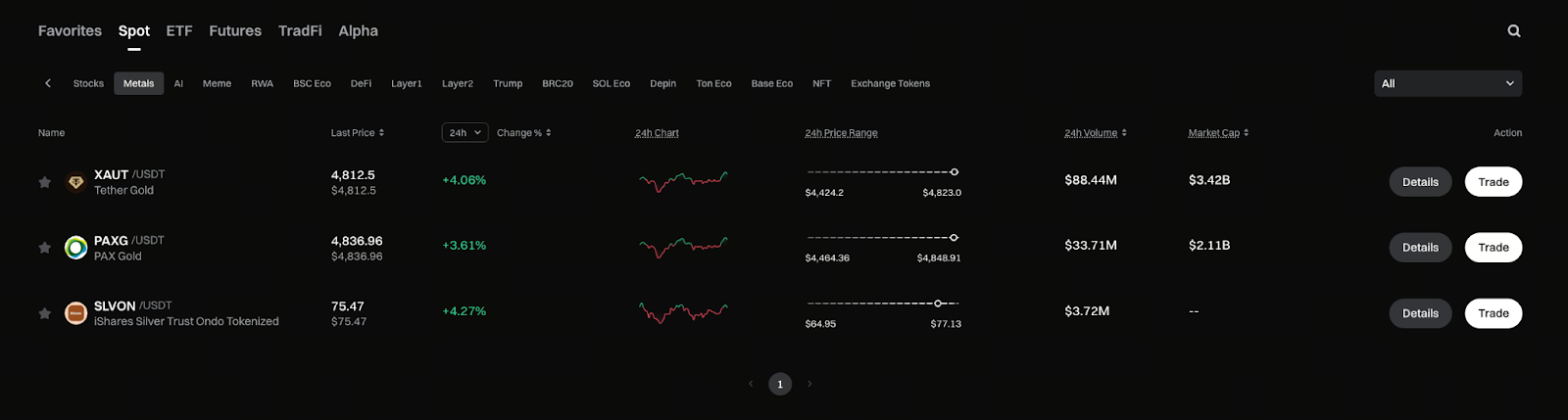

Chart: https://www.gate.com/price/category-metals

High-volatility markets create trading opportunities but also raise the bar for operational complexity and execution speed. Traditional spot or OTC metals trading is limited by trading hours, settlement, and delivery processes. During extreme volatility, failure to enter or exit positions promptly can directly increase losses. Traders need a platform that enables instant entry and exit, unified settlement, clear risk management rules, and ample liquidity. Gate’s metals section is purpose-built for these demands, transforming the hedging and risk management features of traditional metals into more flexible trading tools.

Key Features and Design Highlights of Gate’s Metals Section

  • 24/7 Perpetual Contract Trading — Volatility-driving news and events can break at any time. Around-the-clock trading lets users execute stop-loss/take-profit orders and adjust positions whenever needed, enabling timely responses to market shifts.
  • USDT-Settled Contracts — Unified stablecoin settlement streamlines fund management and currency conversion, making settlements faster and more intuitive.
  • Indexed Pricing from Multiple Markets — By referencing prices from several major markets to form the contract index, the system reduces the impact of anomalies in any single market or exchange, improving price transparency.
  • Advanced Contract Risk Management and Clearing — Margin requirements, tiered risk limits, insurance funds, and dynamic liquidation mechanisms give users clear risk boundaries, even in extreme volatility.
  • Diverse Trading Tools — Leverage trading, hedged positions, and cross-asset arbitrage access support a wide range of trading strategies.

Together, these features deliver higher execution efficiency and clearer risk parameters for users navigating highly volatile market conditions.

Practical Trading and Risk Management Strategies on Gate

  • Beginner/Conservative: Limit position sizes and use low or no leverage for short-term hedging or swing trading. Always set clear stop-losses and position caps.
  • Intermediate/Arbitrage: Leverage price differences between spot and contracts, or between metals and crypto assets, for cross-market arbitrage—while carefully evaluating funding rates, slippage, and fees.
  • Advanced/Trend Trading: Once a trend is confirmed, build positions in stages and use trailing stop-losses to avoid taking full risk exposure at once during high volatility.
  • Hedged Portfolio Strategies: Use metal contracts as hedging tools within a crypto asset portfolio to reduce overall volatility (while monitoring funding rates and holding costs for long-term positions).

Regardless of strategy, be mindful that liquidity can temporarily tighten during high volatility, and slippage or execution delays may increase actual trading costs. Prudent position sizing and use of platform risk management tools are especially critical.

Risk Warning and Conclusion

High volatility in metal markets brings both opportunities and greater operational risk. Platform tools can reduce execution and settlement friction, but cannot eliminate market risk itself. When trading in Gate’s metals section, users should fully understand the leverage features of perpetual contracts, funding rate mechanisms, and platform liquidation rules, and manage positions and stop-losses appropriately. Gate will continue to enhance its risk management and price reference mechanisms to support users in executing sound trading decisions in complex market environments.

Author: Max
Disclaimer
* The information is not intended to be and does not constitute financial advice or any other recommendation of any sort offered or endorsed by Gate.
* This article may not be reproduced, transmitted or copied without referencing Gate. Contravention is an infringement of Copyright Act and may be subject to legal action.

Related Articles

The ve(3,3) Flywheel Explained: How AERO Tokenomics Powers Aerodrome’s DeFi Economy
Beginner

The ve(3,3) Flywheel Explained: How AERO Tokenomics Powers Aerodrome’s DeFi Economy

In the competition for DeFi liquidity, high-inflation mining alone is no longer enough to build lasting advantages. Aerodrome applies the ve(3,3) economic model to redesign token emissions, voting mechanisms, and revenue distribution, creating a liquidity flywheel centered on governance and cash flow. This article examines AERO tokenomics, the veAERO locking mechanism, and protocol revenue models to explain how Aerodrome builds a sustainable DeFi economic system.
2026-03-25 06:41:58
AI-Native Settlement Layers: How United Stables Is Building the Next Financial Rail
Beginner

AI-Native Settlement Layers: How United Stables Is Building the Next Financial Rail

Stablecoins were originally designed as dollar substitutes within exchanges, primarily used for asset pricing and trade settlement. As on-chain financial ecosystems have matured, their role has expanded beyond simple payments to include collateral assets, cross-chain liquidity mediums, and unified settlement units. In particular, as AI systems and automated agents begin to participate directly in economic activity, demand has risen sharply for programmable value units capable of instant settlement. This shift is pushing stablecoins toward the role of foundational financial infrastructure.
2026-03-25 03:16:17
Aerodrome Tokenomics: How ve(3,3) Powers Base's Most Profitable DEX
Beginner

Aerodrome Tokenomics: How ve(3,3) Powers Base's Most Profitable DEX

AERO is the native token of Aerodrome Finance, a core decentralized exchange and liquidity protocol in the Base ecosystem. It is primarily used for liquidity incentives and ecosystem operations. veAERO is a governance NFT that users receive by locking AERO, representing both voting power and the right to share protocol revenue. Through a dual track structure of AERO as a utility token and veAERO as a governance credential, Aerodrome separates liquidity usage value from long term governance power, allowing participants to act as liquidity providers, governance decision makers, and revenue sharers within the same system.
2026-03-25 06:40:31
How Does PAXG Work? In-Depth Overview of the Physical Gold Tokenization Mechanism
Beginner

How Does PAXG Work? In-Depth Overview of the Physical Gold Tokenization Mechanism

PAXG (Pax Gold) is a tokenized asset backed by physical gold, issued by the fintech company Paxos and traded on the Ethereum blockchain as an ERC-20 token. The core concept is to tokenize physical gold on-chain, with each PAXG token representing ownership of a certain amount of gold. This structure enables investors to hold and trade gold in the form of a digital asset.
2026-03-24 19:12:51
How is the price of PAXG determined? Pegging mechanism, trading depth, and influencing factors
Beginner

How is the price of PAXG determined? Pegging mechanism, trading depth, and influencing factors

PAXG (Pax Gold) is a tokenized asset backed by physical gold reserves, launched by fintech firm Paxos and issued as an ERC-20 token on the Ethereum blockchain. The core concept is to digitally represent real-world gold assets, allowing investors to hold and trade gold via the blockchain network. Because each PAXG token corresponds to a specific quantity of physical gold, its price is theoretically expected to closely track the global gold market.
2026-03-24 19:11:40
DePIN Identity Network and Real World Applications: How Humanity Protocol Brings on-chain Identity Into the Physical World
Beginner

DePIN Identity Network and Real World Applications: How Humanity Protocol Brings on-chain Identity Into the Physical World

Most Web3 identity systems remain confined to on-chain environments and struggle to achieve meaningful adoption in real world settings. Through a DePIN architecture and physical verification hardware, Humanity Protocol aims to bring decentralized identity into access control systems, hospitality, public services, and offline events, allowing on-chain identity to function not just as a digital credential, but as foundational infrastructure for real world access.
2026-03-25 07:40:53





