The core distinction between AKEDO and traditional GameFi or general AI creation tools lies in their foundational approach: traditional GameFi emphasizes long-term development by professional teams and intricate gameplay tokenomics, while general large language models typically generate only text or code snippets, falling short of producing fully playable games. AKEDO (AKE) leverages four specialized Agents, a Creation Engine, and a Launchpad to transform natural language prompts into playable content, all within a closed-loop $AKE incentive structure.
At the intersection of GameFi and generative AI, creators face the dual challenge of overcoming the high entry barriers of blockchain game development and the limitations of general-purpose tools that "can write code but can’t deliver playable levels." From a blockchain perspective, traditional GameFi typically revolves around a single project’s tokenomics, and general AI solutions lack integrated Launchpad functionality. In contrast, AKEDO unifies the creation engine, publishing tools, and $AKE tokenomics into a cohesive framework. This comparison is structural, not an evaluation of superiority.
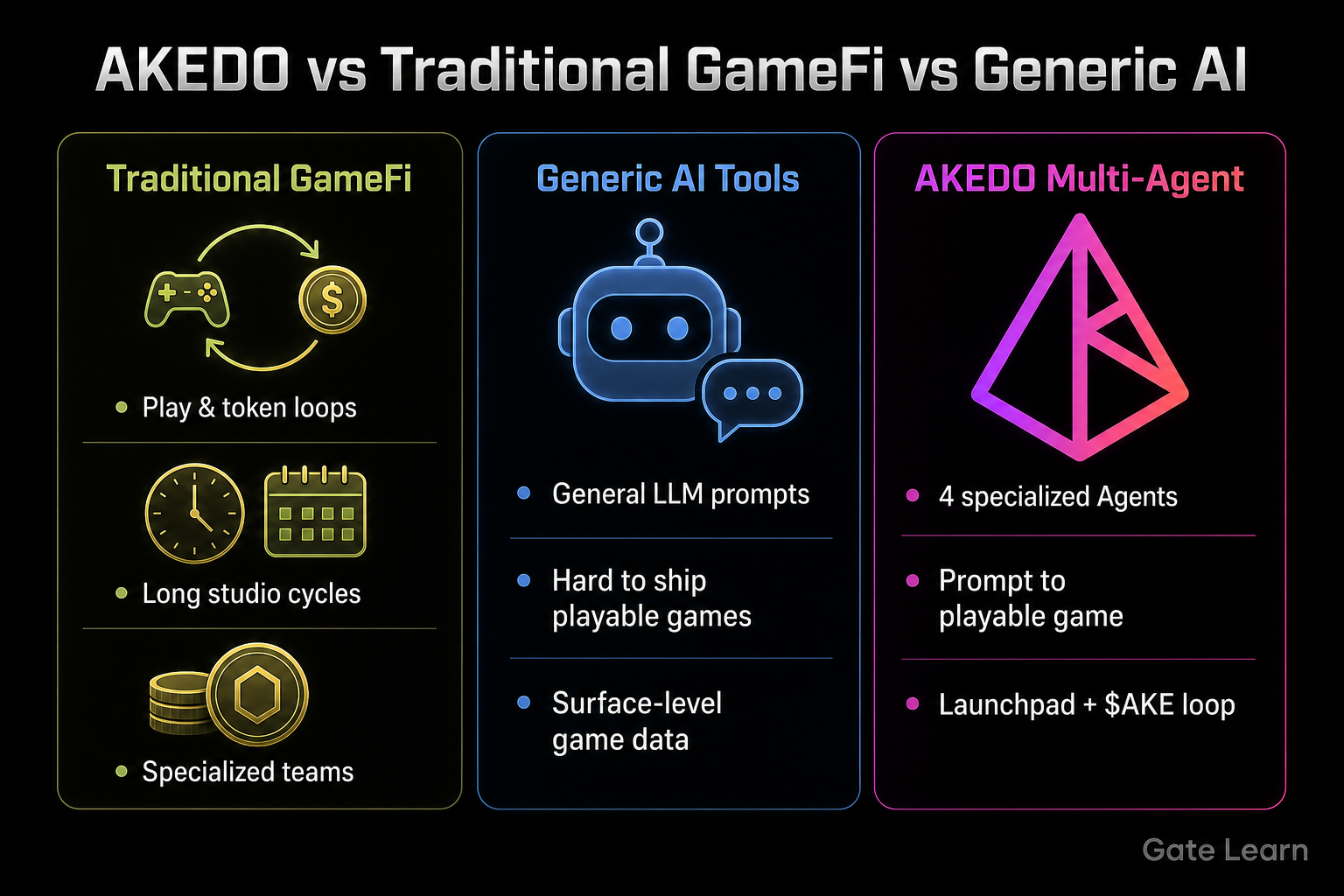 Caption: Three-way comparison of traditional GameFi, generic AI tools, and AKEDO across development focus, playable output, and the Launchpad/$AKE incentive loop.
What Is Traditional GameFi?
Traditional GameFi refers to products that integrate on-chain assets, token incentives, and playable games. Players participate in the economic ecosystem through gameplay, tasks, or asset holding, while project teams use tokens, NFTs, or points to structure supply and demand. The primary focus is on gameplay design, numerical balancing, and tokenomics—not on instantly building engines through natural language.
Development typically relies on professional studios, with extended timelines from prototype to launch. Economically, many projects are "gameplay-driven," emphasizing token demand, with mechanisms like gold farming, staking, and guilds designed to drive token velocity and retention. Issuance is usually limited to single-project tokens or NFTs, lacking standardized UGC tools connected to a Launchpad. The hallmark is "long-term professional production plus a gameplay-token closed loop."
General AI creation tools are conversational or code-assistant products powered by large language models (LLMs), enabling users to generate copy, script snippets, or partial code via natural language. Their strength is breadth—explaining concepts, drafting documents, completing functions—while their weakness is assembling disparate outputs into a functional, balanced, and publishable game.
According to the whitepaper, most general LLMs only capture surface-level representations and struggle to organically assemble them into functional games. Users are often left with map descriptions, rule drafts, or isolated scripts and must still handle engine integration and publishing themselves. "Generating ideas" isn’t the same as "delivering a playable prototype." On the economic side, general tools rarely offer integrated Launchpads, protocol revenue sharing, or ecosystem token-based payment for creation, and do not form a "creation → publishing → token incentive" loop by default.
How Does Multi-Agent Specialization Differ?
In traditional GameFi, specialization comes from human team roles; general AI relies on users refining prompts, with the model remaining a single, general interface. AKEDO divides responsibilities among four specialized Agents: World Builders (maps), Rule Designers (mechanics), Balancers (fairness and difficulty), and Storytellers (narrative). After receiving a natural language prompt, each Agent completes its module in parallel or sequence, emulating traditional production workflows and enabling modular iteration.
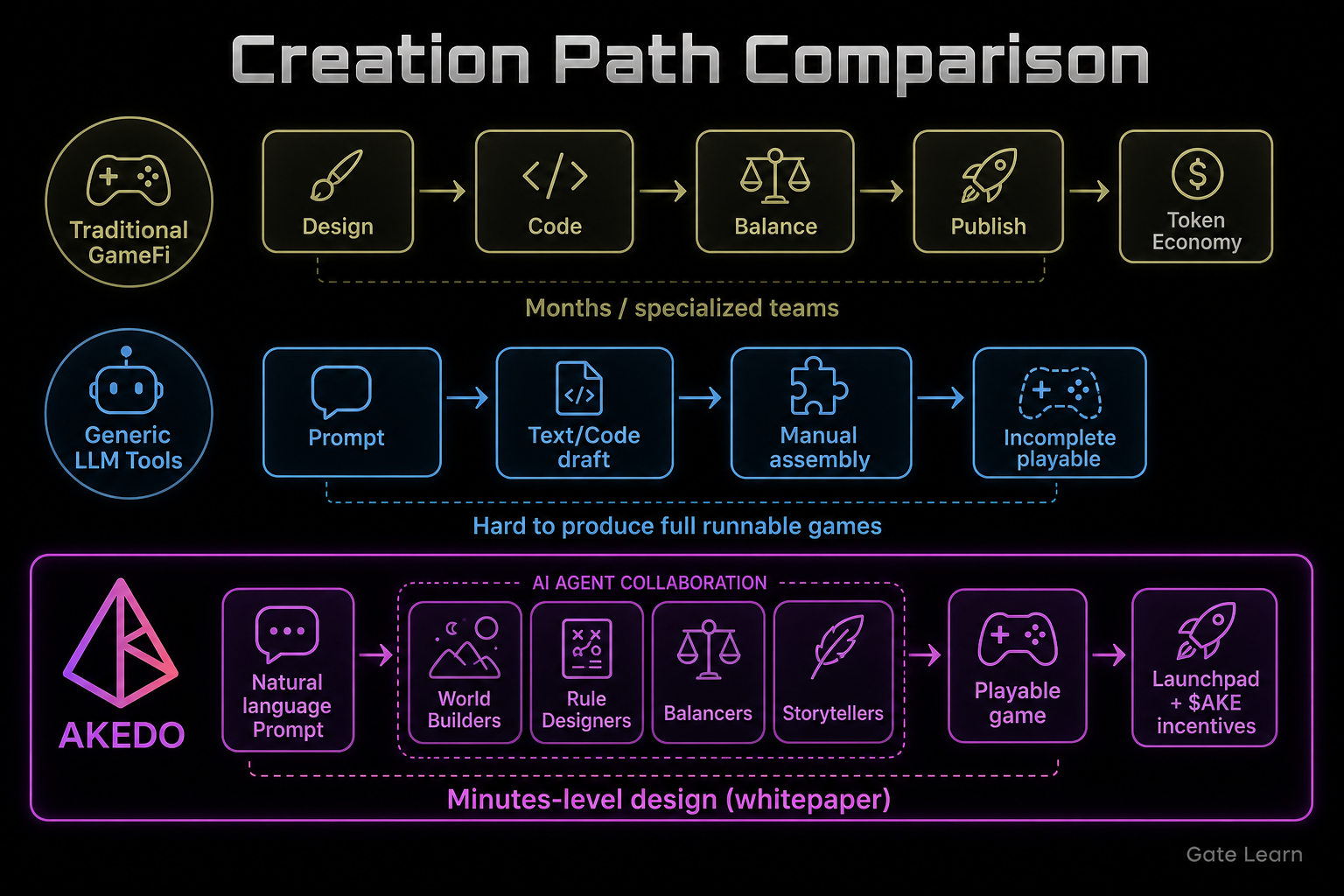 Figure 1. Three creation paths compared: traditional GameFi’s long pipeline, generic LLMs’ challenge in delivering full playability, and AKEDO’s four-Agent workflow from prompt to playable content.
Compared to "one-shot code generation," a multi-agent system translates intent into operational modules—a process known as vibe coding. This is a mechanistic distinction and does not imply that all scenarios should replace traditional teams or general assistants.
How Do Creation Barriers and Speed Differ?
Traditional GameFi demands coordination in programming, engine development, and operations, resulting in high individual entry costs. General AI lowers the expression barrier, but "idea to playable" remains bottlenecked by engine integration and publishing. AKEDO lowers the entry point to natural language prompts, supported by templates for RPG Dungeon, Adventure, Survival, Narrative, and more.
In terms of speed, traditional projects take months; general tools can produce drafts in minutes, but moving from draft to playable is uncertain. The AKEDO whitepaper claims a playable game can be designed in about two minutes, dramatically reducing development time. This efficiency applies to the creation and prototyping phase, not guaranteed returns; quality still depends on Agents, manual review, and iteration.
How Do Launchpad and Tokenization Differ?
Traditional GameFi typically pre-designs token and NFT economics before embedding gameplay; standardized UGC tools connected to publishing are rare. General AI tools usually stop at the draft phase, lacking native bonding curves, game collection tokens, or liquidity pairing with ecosystem tokens.
AKEDO places the Creation Engine alongside the Creator Launchpad: after creation, content can be published and tokenized. $AKE is used for creation and publishing payments, staking revenue sharing, and new game token liquidity pairing. AKEDO’s creator monetization mechanisms also span ad games, protocol revenue sharing, and platform ad revenue. Adodo and the AKEDOG NFT ecosystem strengthen the community asset layer through pets and card/NFT features. Tokenization introduces volatility and smart contract risks; the key difference is whether it connects to on-chain publishing and incentives, not projected returns.
Core Differences at a Glance
The table below compares the three across development entity, content output, publishing tools, and incentive structure.
| Comparison Dimension |
Traditional GameFi |
General AI Creation Tools |
AKEDO |
| Development Entity |
Professional studio, long pipeline |
User + general LLM/assistant |
Creator + four specialized Agents |
| Content Output |
Playable games, slow iteration |
Text/code snippets, hard to play directly |
Prompt-driven playable content (whitepaper: ~2-minute design) |
| Publishing & Tokenization |
Project-level tokens/NFTs |
Usually no native Launchpad |
Creation Engine + Launchpad |
| Incentive Loop |
Gameplay-driven tokenomics |
Mostly tool subscription or free quota |
$AKE payments, staking revenue sharing, ads/protocol revenue sharing in parallel |
| Data & Models |
Project-private content assets |
General corpus, hard to form functional games |
Platform-exclusive content data, emphasizing differentiation from general models |
This table highlights: traditional GameFi excels at complete playability and economic design; general AI is strong in draft efficiency; AKEDO stands out for its multi-agent structure and seamless creation-to-launch-to-token workflow. Each model has distinct challenges and is not simply "better" or "worse" than the others.
What Are the Limitations in Comparison?
First, the "about two minutes to complete design" claim comes from the whitepaper; actual quality varies by template and prompt and shouldn’t be extrapolated as a guarantee of returns. Second, there is significant diversity within traditional GameFi, so a single label oversimplifies the landscape. Third, general AI iterates rapidly, and some products are now integrating engine plugins; the comparison here focuses on the difference between "general conversational generation" and "game-focused multi-agent + Launchpad" mechanisms.
On the risk side, Launchpad and tokenization introduce contract, liquidity, and imitation risks; multi-agent systems rely on models and on-chain infrastructure; confusion may arise when entry and BSC settlement layers are mixed. These limitations define mechanism boundaries and do not constitute investment advice.
Summary
Traditional GameFi, general AI, and AKEDO represent three distinct paths: professional teams delivering long-term playability and gameplay tokenomics; general models offering high expressive efficiency but struggling to deliver fully functional games; and AKEDO’s four specialized Agents driving the Creation Engine, seamlessly connecting with the Launchpad and the $AKE incentive loop. The whitepaper emphasizes efficiency and the ability to assemble playable content as a creation mechanism—not as a revenue guarantee. Understanding these differences requires examining division of labor, entry barriers, publishing tools, and incentive structures.
FAQ
What Is AKEDO?
AKEDO is a multi-agent AI framework designed for autonomous content creation, offering both a game and content creation engine and a publishing launchpad. Creators use natural language prompts to drive specialized Agents that generate playable games and interactive content, and can participate in the ecosystem through the Launchpad, $AKE payments, and ad/protocol revenue sharing.
How Is It Different from Traditional GameFi?
Traditional GameFi relies on long-term development by professional teams, with an economic focus on gameplay and project token cycles. AKEDO centers on multi-agent creation driven by natural language, integrating the Creation Engine, Launchpad, ad revenue sharing, protocol revenue sharing, and $AKE incentives in parallel. Key differences include the creation barrier, content supply speed, and revenue source combinations, without making value judgments.
How Do You Make Games with AI?
With AKEDO, creators input natural language settings, and World Builders, Rule Designers, Balancers, and Storytellers handle map design, mechanics, balance, and narrative, respectively, producing playable content. The whitepaper claims design can be completed in about two minutes. General AI tools can generate rule or code drafts but still require manual engine integration and publishing.
What Is a Multi-Agent Framework?
A multi-agent framework consists of multiple AI Agents, each with specialized expertise, collaborating by module rather than completing all tasks through a single conversation. AKEDO divides game production into dedicated roles—maps, rules, balance, and narrative—coordinated by large language models, making it easier to translate natural language intent into functional modules.
Why Can’t General AI Tools Directly Produce Complete Games?
The whitepaper notes that most general LLMs only capture surface representations and struggle to organically assemble them into functional games. Users typically receive text descriptions or code snippets, lacking engine integration, balancing, and publishing tools. General assistants are best for drafting and are not equivalent to frameworks with built-in Creation Engine and Launchpad for games.
What Is Most Commonly Misunderstood in Comparison?
A frequent misconception is equating "faster creation" with "better returns," or viewing the three approaches as interchangeable. Efficiency claims refer to development and prototyping speed; tokenization and ad revenue introduce contract and traffic variables. Choosing a solution should be based on the need for playable delivery, publishing tools, and incentive loops—not on simplistic rankings.