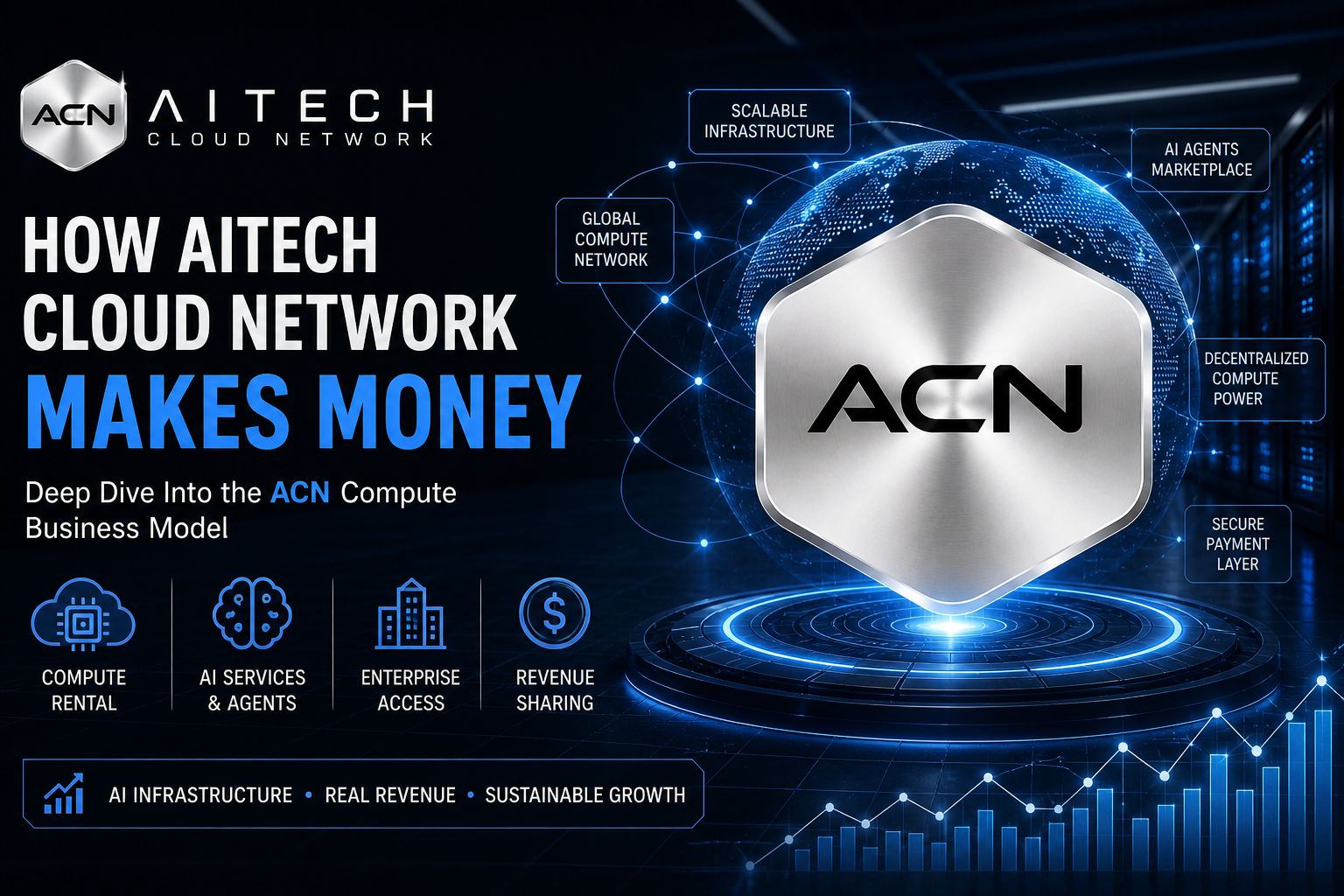
The business value of AI computing networks goes far beyond simply owning GPU resources—it hinges on the ability to turn computing power into services that are billable, callable, and reliably delivered at scale. For developers, enterprises, and AI Agent applications, factors such as computing costs, service uptime, and payment efficiency all shape the platform’s revenue model.
This challenge typically spans six dimensions: the computing power marketplace, AI services, enterprise clients, fee settlement, revenue allocation, and growth drivers. The AITECH Cloud Network official site highlights its focus on enterprise-grade AI compute infrastructure, emphasizing Tier III availability, 99.98% uptime, transparent market pricing, and decentralized computing infrastructure.

ACN’s business model is an infrastructure-centric fee framework built around AI computing power and intelligent services, seamlessly integrating GPU computing, Agent services, and blockchain settlement into a unified commercial loop.
The network first provides computing resources and service entry points. Users then access computing power or AI tools based on their task requirements, complete payments and settlements through the platform, and revenue flows among service providers, the platform, and ecosystem participants. The official site describes this as a unified network enabling access to high-performance computing and scalable AI and Agent systems.
Crucially, this model’s revenue is not tied to a single token narrative, but is driven by actual use of computing power and AI services. The more frequently the network is used, the more opportunities the platform has to generate revenue via service fees, resource allocation, and ecosystem settlements.
Leasing computing power is the most direct revenue stream for AI computing networks, with users paying for GPU resources, inference tasks, or large-scale computational needs.
The process begins with users selecting the required computing resources, such as AI training, model inference, or data processing. The system matches computing capacity based on task scale, resource type, and duration. Users then pay the associated fees, the platform allocates the tasks to the appropriate resources, and the delivery of computing power generates revenue that supports network operations.
The closer computing power leasing aligns with real-world demand, the clearer the revenue model becomes. AITECH Cloud Network emphasizes its enterprise-scale AI compute infrastructure, signaling that its business foundation targets not just on-chain users but also developers and enterprise clients seeking stable computational resources.
AI services are billed on-demand for model calls, Agent workflows, data processing, and automation tasks. The core idea is to break down complex AI capabilities into modular service units that users can directly purchase and invoke.
In practice, users access the AI service or Agent tool portal, select a model, workflow, or automation task, and the system calculates fees based on service complexity, execution count, resource consumption, and invocation method. Users pay, the platform executes the task, and returns the result. Service calls then become a revenue stream for the platform.
| Revenue Module | User Action | System Action | Revenue Source |
|---|---|---|---|
| Computing Power Leasing | Select GPU resources | Allocate computing power | Resource usage fees |
| Agent Forge | Create or call Agent | Execute workflow | Service call fees |
| Enterprise Access | Use stable infrastructure | Provide permissions and services | Enterprise service fees |
| Platform Settlement | Pay for services | Complete allocation and record | Transaction and service revenue |
As shown above, AITECH Cloud Network’s revenue logic is not a simple subscription—it’s a composite of computing power, AI Agent, enterprise services, and settlement mechanisms. Official updates also note that Agent Forge supports both standard API keys and x402 payments, enabling developers and Agents to access services through multiple channels.
Enterprise clients prioritize stability, resource availability, service costs, and compliant integration methods when connecting to the ACN network. Rather than making one-off purchases, enterprises integrate AI computing as an ongoing part of their business systems.
The process starts with enterprises selecting computing power, AI Agent, or data processing services tailored to business needs. The system then provides access permissions, API endpoints, or platform tools. Enterprises pay based on actual usage, service bundles, or contract terms, and the platform delivers ongoing services, generating recurring revenue.
This mechanism is vital because enterprise clients typically have more stable and higher-frequency computational needs. Compared to retail users, enterprises are more likely to generate sustained revenue through model inference, automated customer support, data analytics, workflow execution, and dedicated computing configurations.
Revenue allocation is critical to the viability of the business model, requiring the platform to establish a transparent value flow among service providers, infrastructure participants, and the broader ecosystem.
Users pay for computing power or AI services, and the platform attributes revenue based on the type of service—whether computing resources, Agent execution, or platform tools. A portion of revenue rewards service providers, while the rest supports platform operations, ecosystem development, or token mechanisms. Ultimately, revenue distribution determines whether participants remain motivated to supply resources and services.
Official materials highlight Compute Marketplace and Agent Forge as ongoing development priorities, with updates on payment integration, infrastructure, and feature enhancements. This underscores that revenue allocation is tied not only to token economics, but also to product functionality, service delivery, and developer participation.
The sustainability of the business model depends on computing power demand, enterprise adoption, Agent service usage, and the platform’s delivery capabilities. Sustained revenue must come from ongoing usage, not just one-off activity.
AI application growth drives computing power demand. Developers and enterprises access computing resources and Agent services through the platform, generating fees that fund operations and ecosystem incentives. If service quality, pricing efficiency, and delivery remain stable, the business model has a solid foundation for long-term sustainability.
Key challenges remain. The AI computing market is highly competitive, with traditional cloud platforms enjoying strong resources and customer bases. Decentralized computing networks must still prove their pricing, reliability, and service experience. ACN’s ability to scale hinges on its capacity to continuously connect computing resources, Agent tools, and enterprise needs.
AITECH Cloud Network’s profit engine centers on computing power leasing, AI service calls, Agent Forge, enterprise client integration, and platform settlement. The business process can be summarized as users submitting computing or service requests, the system allocating computing power or Agent tools, users completing payment, the platform delivering services, and revenue being distributed.
In essence, ACN’s business model does not simply depend on tokens, but on real-world use of AI computing power and intelligent services. Computing power demand, enterprise integration, Agent service usage, pricing models, and service reliability are the variables that determine sustained revenue.
AITECH Cloud Network generates revenue primarily through AI computing power leasing, Agent Forge service usage, enterprise-grade infrastructure integration, and platform settlement. Its business model is built on actual use of computing resources and AI services.
Computing power leasing directly addresses high-frequency needs such as AI training, model inference, and data processing. Users pay for GPU resources and computing time, so higher utilization translates to greater revenue potential for the platform.
Agent Forge generates revenue through AI Agent creation, workflow execution, API calls, and service payments. When users or developers invoke Agent services, the platform charges based on task execution or resource consumption.
Enterprise clients typically require stable computing power, API integration, automation tools, and ongoing services, making them a reliable source of recurring revenue. The extent of enterprise adoption directly impacts the stability of the platform’s business model.
Major risks include competition in the computing power marketplace, hardware and operational costs, speed of enterprise adoption, service reliability, and platform usage. If real service demand falls short, both revenue growth and the token mechanism will be adversely affected.