Ahead of the OpenAI IPO, 10 publicly traded AI stocks are frequently referenced in industry discussions: Nvidia (NVDA), AMD (AMD), Broadcom (AVGO), Microsoft (MSFT), Alphabet (GOOGL), Amazon (AMZN), Salesforce (CRM), ServiceNow (NOW), Adobe (ADBE), and Palantir (PLTR).
Because OpenAI is not yet listed on any exchange, these stocks provide a framework for understanding the AI industry chain but do not represent OpenAI equity or Gate Pre-IPOs’ OPENAI mirrored notes. The OpenAI corporate entity and platform product rules should be considered separately.
How Are These 10 AI Stocks Structured Within the Industry Chain?
Publicly traded AI stocks are typically organized into three vertical layers: hashrate, cloud and platform, and application and software. As OpenAI remains unlisted, retail investors cannot directly trade its shares; in the absence of a ticker, those seeking exposure often look to listed AI stocks to infer OpenAI’s ecosystem positioning. Comparative analysis provides structural context, but does not imply OpenAI equity is accessible.
| Layer |
Core Function |
Key Stocks Among the 10 |
Relationship to OpenAI |
| Hashrate Layer |
AI accelerators, GPUs, network, and chipsets |
Nvidia (NVDA), AMD (AMD), Broadcom (AVGO) |
Represents AI hashrate demand, no OpenAI equity held |
| Cloud & Platform Layer |
Cloud infrastructure, model APIs, enterprise AI contracts |
Microsoft (MSFT), Alphabet (GOOGL), Amazon (AMZN) |
Some business cooperation or competition with OpenAI |
| Application & Software Layer |
CRM, collaboration, databases, vertical software |
Salesforce (CRM), ServiceNow (NOW), Adobe (ADBE), Palantir (PLTR) |
Embeds AI into existing products, primarily application-focused |
These stocks illustrate the division of labor across the industry chain and do not indicate any equity relationship or one-to-one mapping with OpenAI. Each layer’s stocks are tradable on platforms like Gate Stocks, but represent listed company shares—not unlisted OpenAI equity.
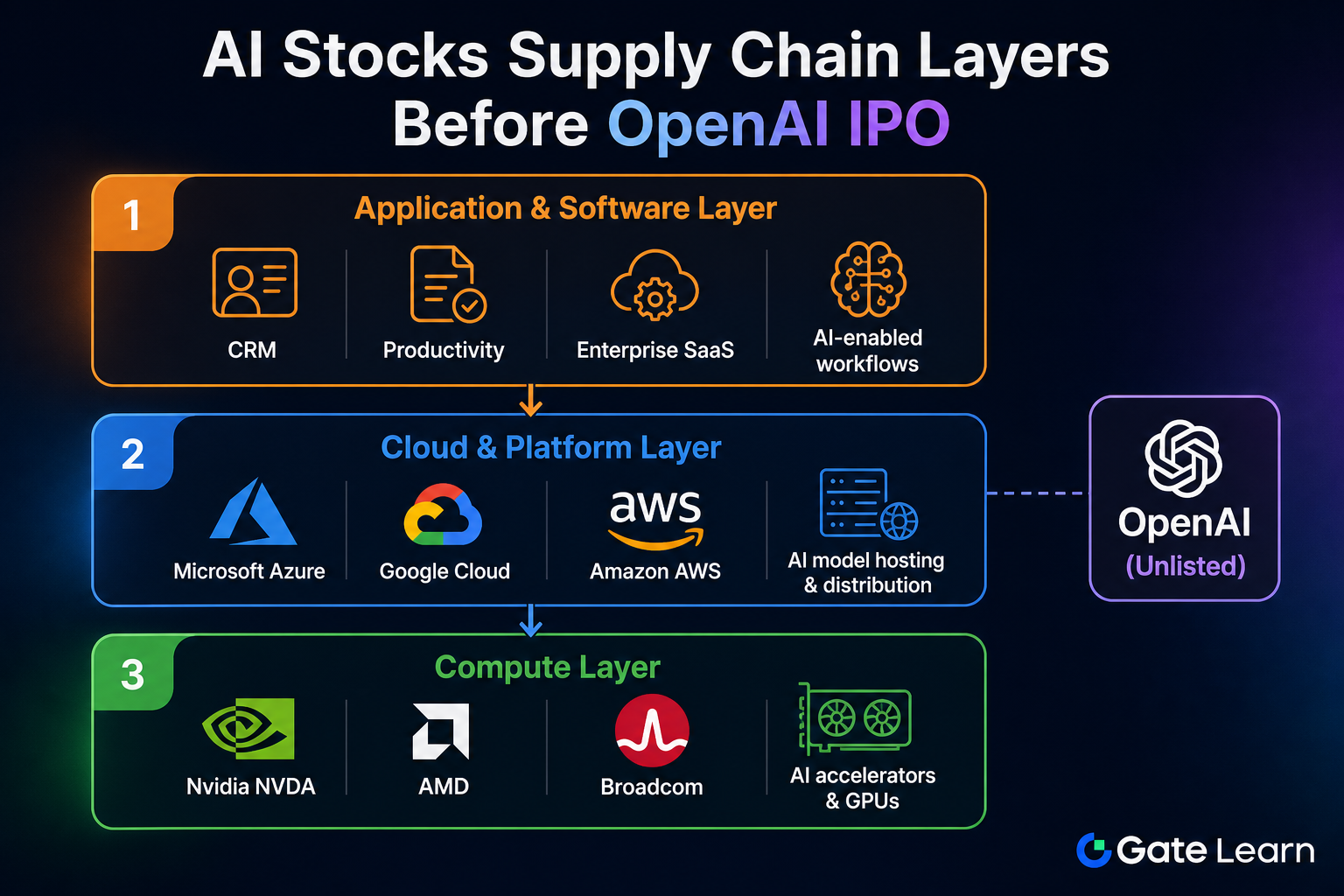 Figure 1. Distribution of frequently referenced AI stocks across the hashrate, cloud platform, and application software layers of the industry chain prior to the OpenAI IPO.
Hashrate Layer: Why Is NVDA the Most Commonly Referenced AI Stock Before the OpenAI IPO?
The core thesis for hashrate layer stocks is the ongoing need for high-performance chips, interconnects, and supporting semiconductors for AI model training and inference. Nvidia (NVDA) is widely recognized as the leading hashrate provider for AI accelerators; AMD (AMD) offers alternative and complementary GPU and data center CPU solutions; Broadcom (AVGO) and others support with custom chips and networking equipment.
Stocks in the hashrate layer reflect hardware cycles, production capacity, client capital expenditures, and competitive dynamics—not OpenAI’s own financing or equity structure. Market discussions of OpenAI and Nvidia typically focus on industry value chain relationships or ecosystem collaboration, not “buying Nvidia equals buying OpenAI.”
Cloud and platform layer stocks represent the AI strategies of hyperscalers and major tech platforms. Microsoft (MSFT) has publicly disclosed commercial and technical partnerships with OpenAI; MSFT shares represent exposure to Azure, enterprise software, and AI services, but do not equate to OpenAI equity. Alphabet (GOOGL) takes a separate platform approach with Google Cloud and proprietary models (such as Gemini); Amazon (AMZN) leverages AWS and proprietary chips (Trainium, Inferentia) to serve enterprise AI workloads.
| Comparison Dimension |
Cloud & Platform Layer Stocks |
OpenAI (Unlisted Entity) |
| Trading Venue |
Listed on stock exchanges |
No public common stock trading |
| Source of Rights |
Public company shares and bylaws |
Private placements, transfers, or platform-mapped products |
| Revenue Model |
Cloud, advertising, retail, and more |
Model APIs, enterprise contracts, research |
| Relationship |
Cooperation, competition, vendor/client |
AI model company being referenced |
The cloud and platform layer is the most frequently cited in “comparable AI stocks” research, as OpenAI’s models are primarily delivered to enterprise users via cloud platforms. However, holding MSFT, GOOGL, or AMZN shares means exposure to the broader business—not direct ownership of unlisted OpenAI equity.
Application Layer: Which AI Software Stocks Are Frequently Included in Comparisons?
Application and software layer stocks integrate AI into CRM, collaboration, data platforms, or vertical industry workflows. Salesforce (CRM), ServiceNow (NOW), Adobe (ADBE), and Palantir (PLTR) are often included in AI-themed baskets or ETFs, reflecting the theme of “AI-enabled software” rather than hardware or model training.
This layer’s comparative value lies in understanding how AI commercialization enters enterprise budgets and subscription revenues, forming upstream, downstream, or parallel relationships with OpenAI’s API and model products. Application layer stocks are more sensitive to macro IT spending, customer renewals, and product integration, with risk profiles distinct from the hashrate layer. Treating these stocks as OpenAI substitutes overlooks the different exposures at model and platform layers.
Does Buying AI Stocks Mean Investing in OpenAI?
Exposure to listed AI stocks and to OpenAI is not interchangeable. The former represents exchange-traded company shares, with rights and obligations defined by share class, corporate bylaws, and applicable laws; the latter—still unlisted—may refer to private equity, fund interests, or mapped products disclosed by platforms like Gate.
Gate Pre-IPOs’ OPENAI is officially a mirrored or contingent payment note, tracking pre- and post-listing market value but not representing actual OpenAI shares. Holders have no shareholder rights such as voting or dividends. Buying NVDA or MSFT does not grant OpenAI shareholder status; holding OPENAI notes is not equivalent to holding the above-listed AI stocks.
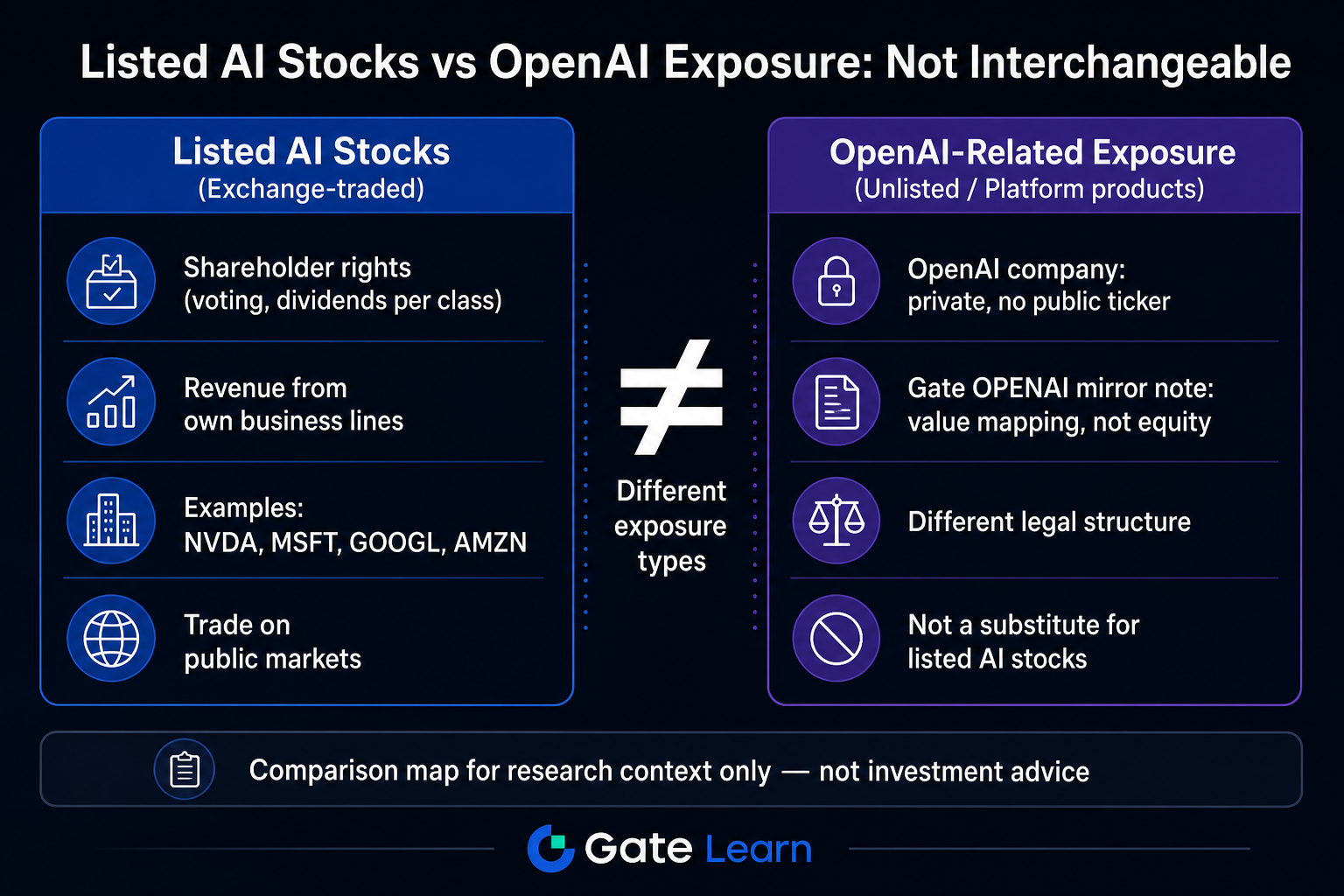 Figure 2. Comparison of listed AI stocks and OpenAI-related exposure in terms of rights structure, trading venue, and legal entity. The two are not interchangeable.
| Exposure Type |
Typical Instrument |
Substitute for OpenAI Equity |
Substitute for Listed AI Stocks |
| Listed AI Stocks |
NVDA, MSFT, GOOGL, etc. |
No |
— |
| OpenAI Private/Direct Equity |
Share transfer arrangements |
Depends on specific documents |
No |
| Gate OPENAI Mirrored Note |
Platform product terms |
No (not actual equity) |
No |
What Should You Check Before Accessing OpenAI Exposure via Gate?
If you shift from “comparable AI stocks” to OpenAI-related products on Gate, you must follow the rules disclosed in product documentation—not conventional stock research frameworks. Always confirm whether the instrument is a listed stock, actual equity, or a mirrored note, and review eligibility, reference standards, corporate actions, and maturity settlement. Research on listed AI stocks cannot substitute for a review of OPENAI product terms.
Summary
Prior to the OpenAI IPO, the 10 referenced AI stocks—NVDA, AMD, AVGO (hashrate); MSFT, GOOGL, AMZN (cloud & platform); CRM, NOW, ADBE, PLTR (application)—are used for industry chain comparison. The three-layer structure helps map OpenAI’s ecosystem role, but each layer’s stocks represent listed company business exposure, not a substitute for unlisted OpenAI equity, nor are they interchangeable with Gate OPENAI mirrored notes. Comparative analysis provides structural context, but any participation requires reviewing the source of rights and disclosure terms for the specific path.
FAQ
What are the top 10 AI stocks to watch before the OpenAI IPO?
The 10 most frequently referenced AI stocks are: hashrate layer Nvidia (NVDA), AMD (AMD), Broadcom (AVGO); cloud & platform layer Microsoft (MSFT), Alphabet (GOOGL), Amazon (AMZN); application layer Salesforce (CRM), ServiceNow (NOW), Adobe (ADBE), Palantir (PLTR). These comparisons help clarify the ecosystem structure and do not imply substitutability for OpenAI exposure.
Which AI stocks should you monitor before the OpenAI IPO?
The same 10-stock list applies: NVDA, AMD, AVGO (hashrate); MSFT, GOOGL, AMZN (cloud & platform); CRM, NOW, ADBE, PLTR (application). This list is for industry chain stratification and is not investment advice.
Does buying AI stocks mean investing in OpenAI?
No. Buying listed AI stocks provides exposure to those companies’ shares; OpenAI is still unlisted, and the public cannot directly trade OpenAI common stock as they can with NVDA. Gate’s OPENAI mirrored note is also not equivalent to actual OpenAI equity.
Which AI stocks are most closely related to OpenAI?
“Most closely related” depends on the comparison dimension: hashrate demand points to chip stocks; model distribution and enterprise contracts point to cloud & platform stocks; AI commercialization points to application software stocks. Microsoft and OpenAI have a public partnership, but MSFT shares cover Azure, Office, and more, and are not equivalent to OpenAI equity.
Can listed AI stocks substitute for OpenAI exposure?
No. Listed AI stocks, OpenAI private equity, and Gate OPENAI mirrored notes are separate legal and settlement entities. Industry chain comparison aids ecosystem understanding but does not provide exposure equivalence.
What is the relationship between OpenAI and Microsoft stock?
Microsoft (MSFT) and OpenAI have public commercial and technical partnerships, with Azure supporting some model distribution and enterprise contracts. However, MSFT shares represent exposure to Microsoft’s overall business, not unlisted OpenAI equity, and cannot be interchanged with Gate OPENAI mirrored notes.
How are Nvidia and OpenAI related in AI stock comparisons?
The two are often discussed in the context of industry value chain partnerships: Nvidia focuses on hashrate hardware and platforms, OpenAI on models and APIs. Holding NVDA provides exposure to chips and hashrate, but not to OpenAI shareholder rights.
What should you review before seeking OpenAI exposure via Gate?
First, distinguish between mirrored notes and actual equity, then review allocation, unlocking, pre-market rules, maturity settlement, and regional eligibility as disclosed. The research framework for listed AI stocks does not replace the need to review OPENAI product terms.