The core difference between ADI Chain and institutional Layer 2 networks such as Arbitrum and Base is that ADI Chain treats government and institutional compliance, native L3 customizable chains, and emerging-market sovereign stablecoin and RWA deployment as network-layer design goals; Arbitrum and Base center on general Ethereum scaling and open application ecosystems, with compliance and jurisdictional rules usually layered on by applications or independent chain-deployment options. That split aligns with the three themes in the ADI Chain overview: compliance-first design, customizable L3s, and emerging-market deployment.
Within the Ethereum Layer 2 landscape, Arbitrum and Base have long occupied high-traffic positions in DeFi and consumer applications; ADI Chain targets government, sovereign entities, banks, and enterprises, prioritizing stablecoin settlement and asset tokenization in emerging markets across the Middle East, Africa, and Asia. In a horizontal comparison, all three inherit Ethereum economic security but serve different roles in proof mechanism, gas token, compliance architecture, and partner resources—not a single ranking of which L2 is stronger or weaker.
What Is ADI Chain?
ADI Chain is an institutional-grade zkRollup Layer 2 network on Ethereum, launched by ADI Foundation. Built on zkSync OS and the Airbender proving system, it executes transactions off-chain and generates zero-knowledge validity proofs submitted to Ethereum mainnet for verification; invalid state cannot be accepted on L1. ADI Chain uses an EVM-compatible execution environment, gas paid in $ADI, and Custom Gas Token support so users and developers can interact on L2 without holding ETH separately.
Architecturally, ADI Chain emphasizes L3 compliant chains: institutions, governments, or industry consortia can deploy Layer 3 ZK Rollups that settle to ADI L2, which itself settles to Ethereum, setting compliance parameters by jurisdiction or business line while sharing ecosystem infrastructure such as Bridgehub for registration and bridging. L3 compliant chains describes how L3 batches settle through Commit, Prove, and Execute stages. The ecosystem spans sovereign stablecoins, RWA tokenization, cross-border institutional settlement, and inclusive finance, with strategic partners including Mastercard, BlackRock, M-Pesa, and ADGM. ADI Chain is not a standalone L1 public chain; it is an Ethereum scaling layer that prioritizes compliance customization and institutional settlement.
What Are Arbitrum and Base?
Arbitrum and Base are both Ethereum Layer 2 networks, but they differ in technical approach, operating entity, and ecosystem focus. Understanding each network's positioning is a prerequisite for comparing them with ADI Chain.
Arbitrum is developed by Offchain Labs and uses Optimistic Rollup (Nitro architecture) with a fraud-proof mechanism; the BOLD system moves fraud-proof challenge paths toward permissionless operation. Arbitrum has a native token, ARB, and an ecosystem known for DeFi depth and Arbitrum Orbit custom chains; institutions such as Robinhood have deployed dedicated chains on Orbit. Orbit allows running independent chains that inherit Arbitrum security, with compliance and KYC designed at the chain or application layer.
Base is built by Coinbase on the OP Stack, has no standalone native token, and its Sequencer is operated by Coinbase. The ecosystem leans toward consumer applications, social products, and retail entry points; Coinbase fiat on-ramps are a distribution advantage. Compliance constraints appear mainly through Coinbase control of the Sequencer and ecosystem partnerships, rather than network-layer multi-jurisdiction L3 partitioning.
| Network |
Rollup Type |
Operator / Developer |
Native Token |
Custom Chain Option |
Typical Ecosystem Focus |
| Arbitrum |
Optimistic Rollup |
Offchain Labs |
ARB |
Arbitrum Orbit |
DeFi, institutional RWA, Orbit dedicated chains |
| Base |
Optimistic Rollup (OP Stack) |
Coinbase |
None |
Superchain member chains |
Consumer apps, social, retail distribution |
| ADI Chain |
ZK Rollup |
ADI Foundation |
$ADI |
Native L3 compliant chains |
Government/institutional compliance, sovereign stablecoins, RWA |
Under the shared trait of being Ethereum L2s, the three networks map to institutional DeFi with Orbit extensions, Coinbase retail distribution, and ADI's compliant L3 and emerging-market deployment paths respectively.
How Do ADI Chain, Arbitrum, and Base Compare?
The table below compares ADI Chain, Arbitrum, and Base across proof mechanism, compliance architecture, gas model, custom-chain capability, and ecosystem partners. The comparison clarifies functional roles; it is not a judgment of which network is better.
| Dimension |
ADI Chain |
Arbitrum |
Base |
| Proof mechanism |
ZK validity proofs (instant cryptographic verification) |
Optimistic Rollup + fraud-proof window |
Optimistic Rollup (OP Stack) |
| Compliance architecture |
Native L3 partitioned by jurisdiction/industry; FATF Travel Rule integration |
Compliance layered at application or Orbit chain level |
Coinbase compliance framework + Sequencer-level controls |
| Gas token |
$ADI (Custom Gas Token) |
ETH (L2 gas denominated in ETH) |
ETH |
| Custom chains |
L3 ZK Rollup; Bridgehub unified registration |
Arbitrum Orbit (Optimistic route) |
Superchain / OP Stack member chains |
| Target users |
Governments, banks, sovereign entities, emerging-market institutions |
Institutional DeFi, developers, Orbit deployers |
Retail users, consumer apps, Coinbase users |
| Ecosystem partner focus |
Mastercard, BlackRock, M-Pesa, ADGM |
Multi-chain DeFi protocols, Robinhood Orbit, and others |
Coinbase, Farcaster, Zora, and consumer ecosystem |
| Geographic focus |
Middle East, Africa, Asia emerging markets |
Global DeFi and institutional deployments |
Global retail; North America distribution strength |
ADI Chain's distinction concentrates on compliance and L3 at the core of network design: institutions can run regulated asset workflows on dedicated L3s while inheriting dual-layer security through L2 and Ethereum. Arbitrum offers mature DeFi and Orbit options, with compliance depth depending on deployer integration. Base's strength lies in Coinbase on-ramps and consumer-grade traffic. $ADI serves both gas and ecosystem settlement roles; $ADI token utility covers allocation and staking mechanics in detail.
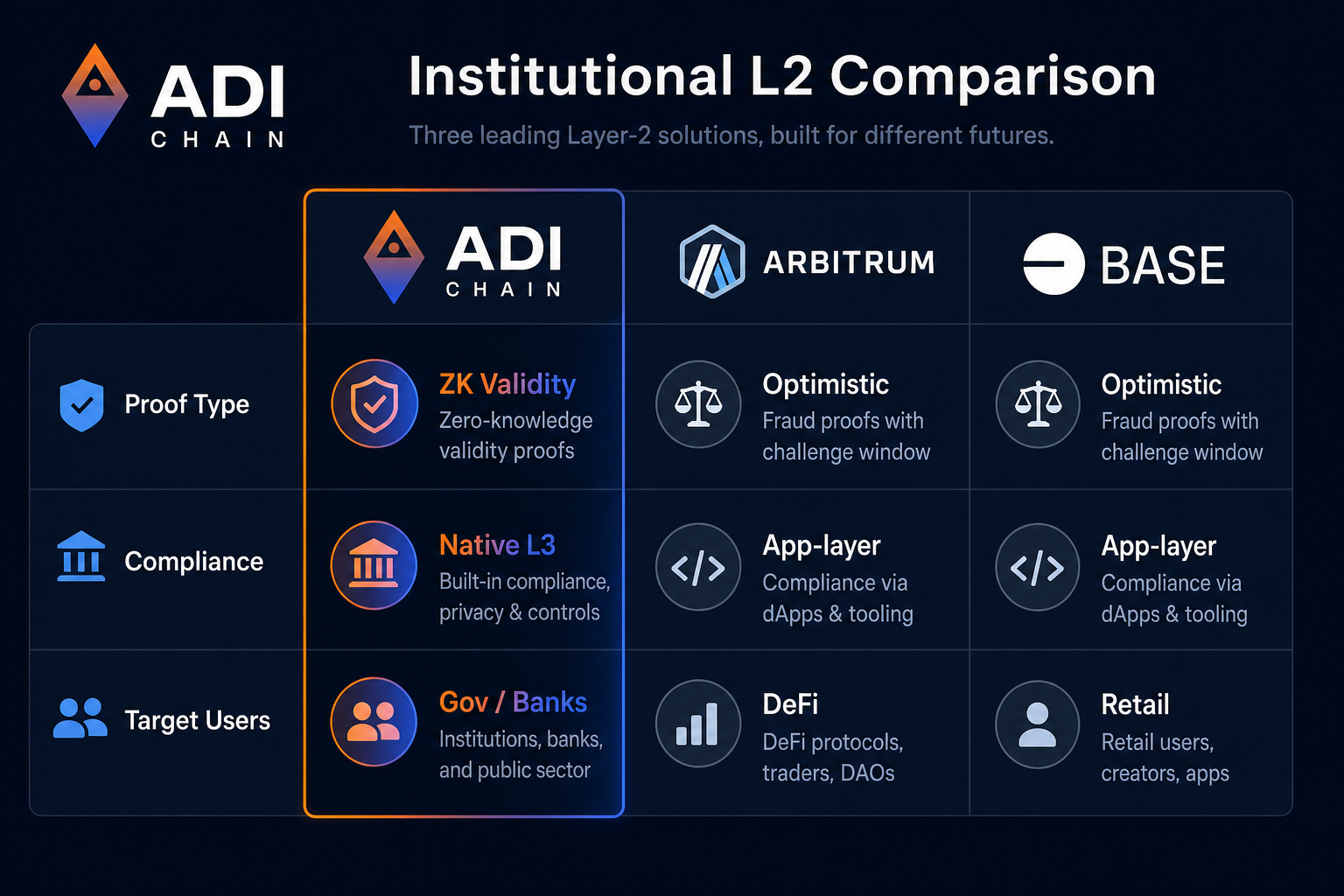 Figure 1. Comparison of ADI Chain, Arbitrum, and Base across proof type, compliance architecture, and target users.
Which Network Fits Which Use Case?
Network choice depends on whether a business needs network-layer compliance partitioning, a preferred proof type, and existing ecosystem or distribution channels—not an abstract performance ranking.
ADI Chain suits governments or banks running sovereign stablecoins, RWA, or cross-border institutional settlement on programmable chains that require compliance policies isolated by jurisdiction; it is also worth evaluating when deployment focus is the Middle East, Africa, or Asia and integration with channels such as ADGM, CBUAE, Mastercard, or M-Pesa is required.
Arbitrum suits scenarios that rely on mature DeFi liquidity and multi-protocol composition, or that need an Orbit dedicated chain on the Optimistic Rollup route with compliance integrated by the team.
Base suits consumer and social products aimed at retail users, or teams that want to leverage Coinbase fiat on-ramps and user distribution; with no native token, projects that depend on governance-token incentives need separate design.
The same institution may combine networks: regulated settlement on an ADI L3, open liquidity on Arbitrum or Base, connected via bridges—provided each jurisdiction's rules are satisfied on a case-by-case basis.
What Are the Limits of Comparing These L2s?
Four structural limits apply when comparing ADI Chain with Arbitrum and Base side by side. Recognizing these boundaries helps avoid reading mechanism differences as absolute superiority.
Ecosystem maturity: Arbitrum and Base have longer track records in DeFi TVL, daily activity, and tooling; ADI Chain remains in an institution-oriented early stage, with lower application density than leading general-purpose L2s.
Compliance is not portable: ADI Chain's L3 framework is designed around dialogues with ADGM, FATF Travel Rule requirements, and similar standards; it does not automatically equate to compliance modules deployed independently on Orbit or Base. Network-layer capability does not mean business compliance is automatically satisfied.
Different proof models: ADI Chain uses ZK validity proofs; Arbitrum and Base use Optimistic Rollup with fraud-proof challenge windows. When comparing latency, distinguish Sequencer soft confirmation from L1 finality—cross-mechanism analogies are misleading.
Sequencer centralization: All three L2s currently operate relatively centralized Sequencers; users should assess bridge contracts and upgrade-key risk. ADI L3 self-operation imposes higher requirements on GPU proving nodes; Base carries dependency on Coinbase's regulatory environment.
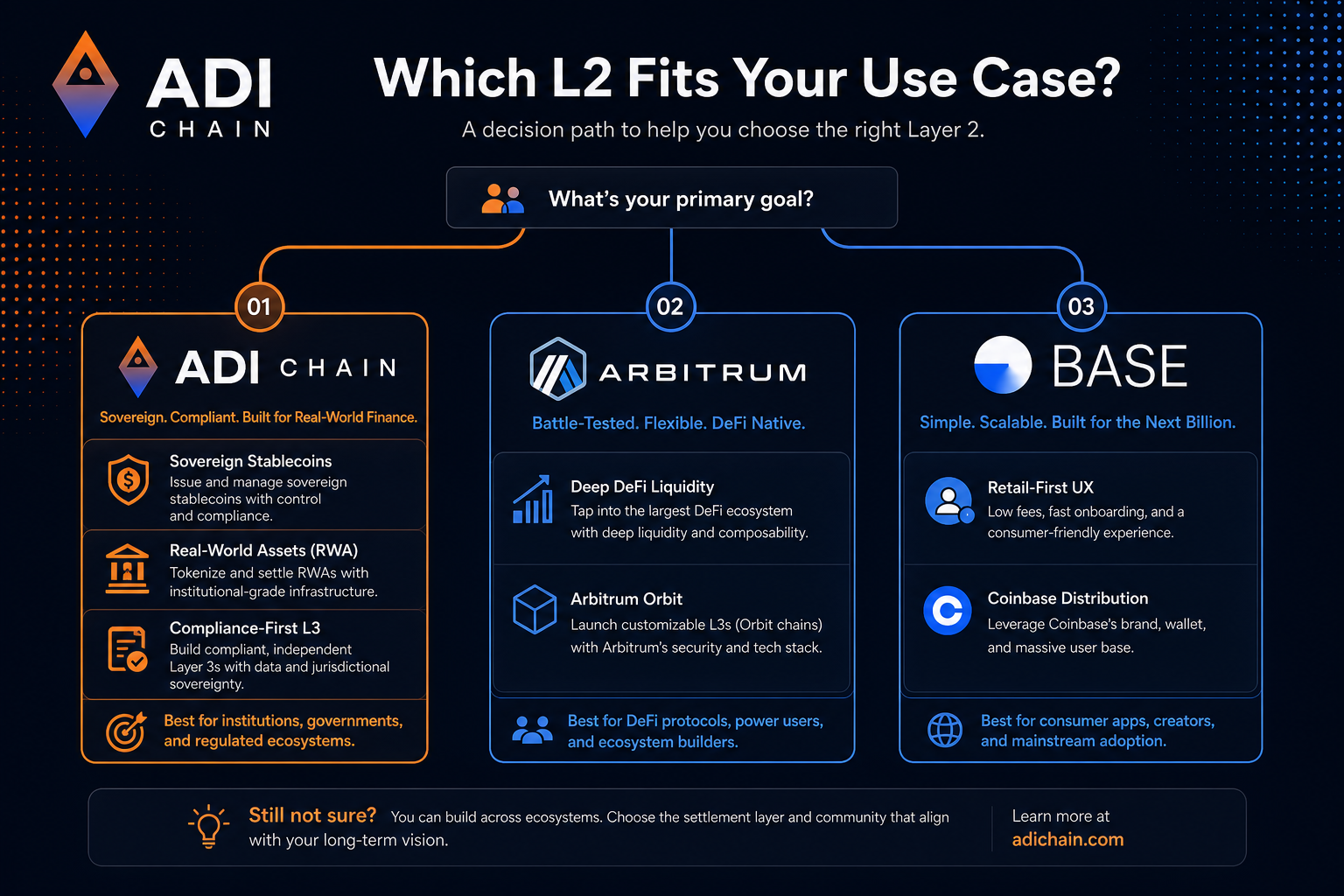 Figure 2. Decision paths for evaluating the three L2 networks across different business scenarios.
Summary
ADI Chain, Arbitrum, and Base are all Ethereum Layer 2 networks but serve different roles: ADI Chain targets institutional compliance, native L3 partitioning, and emerging-market sovereign stablecoins and RWA as network-layer design goals, using ZK Rollup and $ADI gas; Arbitrum is known for Optimistic Rollup and DeFi depth, with custom-chain options through Orbit; Base relies on Coinbase distribution and the OP Stack for consumer and retail applications. Comparisons should match compliance needs, proof type, ecosystem partners, and geographic focus to the scenario—not produce a simple verdict on which chain is best.
FAQ
How is ADI Chain different from Arbitrum and Base?
The core difference lies in compliance architecture and ecosystem focus: ADI Chain provides native L3 compliant chains, ZK validity proofs, and $ADI gas, prioritizing governments, banks, and emerging-market sovereign stablecoin and RWA scenarios; Arbitrum emphasizes DeFi and Orbit custom chains, with compliance mostly integrated by deployers; Base emphasizes Coinbase retail distribution and consumer applications, has no native token, and relies on Coinbase's compliance framework. All three inherit Ethereum security, but target users and network-layer design priorities differ.
Is ADI Chain a public chain or a Layer 2?
ADI Chain is a Layer 2, not a standalone L1 public chain. Transactions execute on ADI L2, and state is finalized on Ethereum mainnet through ZK proofs; institutions can also deploy L3 compliant chains that settle to ADI L2, forming a three-layer security chain of L3 → L2 → Ethereum.
Is ADI Chain secure?
ADI Chain uses ZK validity proofs, so invalid batches cannot be accepted on Ethereum L1; the Sequencer provides second-level soft confirmation, while cryptographic finality requires proof verification to complete on L2 and L1. Users should still assess residual risks from cross-chain bridge contracts, Sequencer operation, and L3 self-operated infrastructure, and distinguish the time gap between soft confirmation and L1 finality.
Are Arbitrum Orbit and ADI Chain L3s the same?
Both allow running relatively independent chains above L2, but technical routes and compliance positioning differ. ADI L3 is a ZK Rollup natively integrated with infrastructure such as Bridgehub, aimed at jurisdiction-specific compliance domains; Arbitrum Orbit follows the Optimistic Rollup route, with compliance and KYC capabilities designed by deployers at the chain or application layer, and an ecosystem focus on DeFi and institution-customized chains rather than ADI-style government and sovereign stablecoin frameworks.
What should be kept in mind when comparing these three L2s?
Four limits matter: ecosystem maturity, non-portable compliance, proof-mechanism differences, and Sequencer centralization. ADI Chain has lower application density than leading general-purpose L2s; Arbitrum and Base Optimistic proofs and ADI ZK proofs should not be directly compared on finality timelines; compliance capability on any L2 cannot replace business-level licensing and risk controls. The goal of comparison is scenario matching, not a unified "best chain" conclusion.







