As decentralized finance (DeFi) continues to develop, decentralized trading protocols have become important infrastructure for the movement of on-chain assets. In this field, different protocols use different trading mechanisms to address liquidity access, price discovery, and trade execution. Among them, the order book model and the automated market maker (AMM) model are the two most representative approaches.
0x Protocol and Uniswap represent these two types of trading mechanisms. 0x Protocol provides liquidity infrastructure for wallets and aggregators through off-chain order broadcasting and on-chain settlement. Uniswap, on the other hand, allows users to trade directly through liquidity pools using an automated market maker model. These two models differ clearly in trading logic, liquidity sources, and suitable use cases, so understanding their differences is important for understanding on-chain trading protocols.
Introduction to 0x Protocol and Uniswap and a Comparison of Their Core Differences
As an open protocol that provides underlying infrastructure for decentralized trading, 0x Protocol’s core goal is to help wallets, aggregators, and decentralized trading platforms access on-chain liquidity efficiently. It uses an architecture that combines off-chain order broadcasting with on-chain settlement, where order creation and matching are handled off-chain, while asset swaps are executed through on-chain smart contracts.
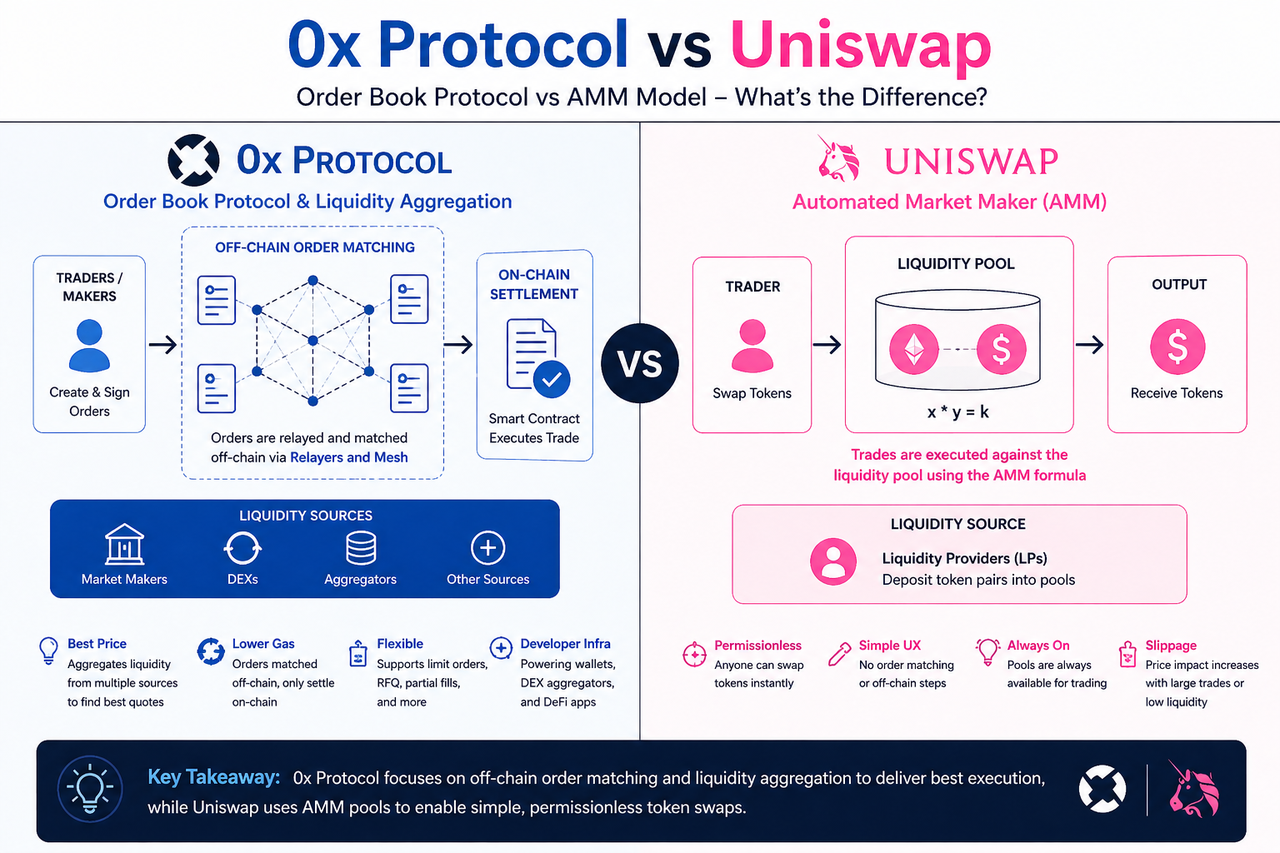
As a decentralized trading protocol based on the automated market maker (AMM) model, Uniswap allows users to exchange assets directly with on-chain liquidity pools without order book matching. Prices are automatically determined by the ratio of assets in the liquidity pool and adjusted through mathematical formulas.
The differences between 0x Protocol and Uniswap cover core mechanisms, liquidity sources, trade execution methods, users, and use cases.
| Comparison Dimension |
0x Protocol |
Uniswap |
| Core Mechanism |
Order book + aggregated routing |
Automated market maker (AMM) |
| Liquidity Sources |
Aggregates liquidity from multiple sources |
On-chain liquidity pools |
| Trade Execution Method |
Off-chain matching, on-chain settlement |
Direct on-chain swaps |
| Main Users |
Developers, aggregators |
End users |
| Main Use Cases |
Wallets, DEX aggregation |
Token swaps |
| Advantages |
Flexible routing, optimized quotes |
Simple to use, direct liquidity |
How Do the Trading Mechanisms of 0x Protocol and Uniswap Differ?
0x Protocol’s trading mechanism relies on order matching logic. After a user creates an order, it is distributed through an off-chain network to find a matching counterparty. Once matched, smart contracts complete settlement on-chain. This mechanism is similar to the order book model used by traditional exchanges.
Uniswap uses an AMM mechanism. After a user initiates a trade, they interact directly with a liquidity pool, and the price is determined by the ratio of assets in that pool. No order matching process is required.
In simple terms, 0x relies on “order matching,” while Uniswap relies on “liquidity pool pricing.”
How Do the Liquidity Sources of 0x Protocol and Uniswap Differ?
In 0x Protocol, liquidity typically comes from market maker orders, external protocols, and aggregated liquidity networks. The protocol integrates multiple liquidity sources through its API to find the best quote route.
In Uniswap, liquidity mainly comes from liquidity pools funded by liquidity providers (LPs). When users trade, they swap directly using the assets held in those pools.
Therefore, 0x liquidity is more like “aggregated liquidity,” while Uniswap uses “pooled liquidity.”
Where Do 0x Protocol and Uniswap Differ in Gas Costs and Efficiency?
0x Protocol reduces on-chain interactions through off-chain order broadcasting and only consumes Gas during trade settlement, which can improve capital efficiency in complex trade routes. This is especially useful when aggregating several liquidity sources, as 0x can optimize execution paths through intelligent routing.
Uniswap’s trading process depends entirely on on-chain liquidity pools, so every trade requires direct interaction with smart contracts. Although the process is simple, transaction costs may rise when the network is congested.
Overall, 0x places more emphasis on routing efficiency, while Uniswap emphasizes a simpler trading process.
How Do the Use Cases of 0x Protocol and Uniswap Differ?
0x Protocol is mainly used for wallet swaps, DEX aggregators, and liquidity infrastructure services. For example, a wallet’s “Swap” feature often uses 0x API to obtain quotes from multiple liquidity sources.
Uniswap is mainly used for end-user token swaps and liquidity provision. Users can trade assets directly through the protocol interface or provide funds to liquidity pools.
This means 0x is closer to an “infrastructure layer,” while Uniswap is closer to an “application layer.”
Conclusion
0x Protocol and Uniswap are both important parts of the decentralized trading ecosystem, but they have different roles. 0x Protocol provides trading infrastructure for wallets and DEXs through an order book and liquidity aggregation mechanism. Uniswap provides users with direct on-chain asset swap services through the AMM model.
At the underlying logic level, 0x focuses more on liquidity integration and trade routing efficiency, while Uniswap emphasizes an instant swap experience without order matching. Understanding the differences between these two models helps build a more complete framework for understanding decentralized trading protocols.
FAQs
Which is better for user trading, 0x Protocol or Uniswap?
Uniswap is more suitable for users who want to conduct on-chain token swaps directly, while 0x Protocol is more commonly used as underlying trading infrastructure for wallets and aggregators.
Why does 0x Protocol not use AMM?
Because 0x mainly aims to aggregate liquidity from multiple sources and optimize trading routes, rather than relying on a single liquidity pool for pricing.
Where does Uniswap liquidity come from?
It comes from assets deposited into liquidity pools by liquidity providers (LPs).
What are the liquidity sources of 0x Protocol?
They include market maker orders, aggregation protocols, and other on-chain liquidity sources.
What is the biggest difference between the two?
The biggest difference lies in their trading mechanisms: 0x uses an order book and liquidity aggregation, while Uniswap uses AMM and liquidity pools.







