This comprehensive analysis examines whether PinGo (PINGO) represents a viable investment opportunity on Gate exchange. As the first AI+DePIN project on the TON network, PINGO integrates artificial intelligence with decentralized computing infrastructure to optimize idle computational resources. The token currently trades at $0.020665 with a market capitalization of $3.82 million, though it has experienced a significant 94.19% year-to-date decline from its $0.45 peak. The article evaluates PINGO's technology differentiation, supply mechanics (18.5% circulating of 1 billion total tokens), and market positioning among 12,291 holders. Price outlook ranges from $0.020-$0.023 short-term to $0.028-$0.046 long-term, contingent on ecosystem adoption and TON network growth. Investment recommendations span beginner dollar-cost averaging strategies through institutional due diligence, with risk management emphasizing 1-10% portfolio allocation based on investor profile and acceptance of substantial volatility inherent t
Introduction: PinGo (PINGO) Investment Position and Market Outlook
PINGO is a digital asset in the cryptocurrency sector that has emerged as a notable AI+DePIN project on the TON network. As of January 30, 2026, PINGO maintains a market capitalization of approximately $3.82 million, with a circulating supply of 185.03 million tokens and a current price around $0.02066. The project positions itself as a bridge for idle computing power resources, addressing fragmented computational infrastructure through the integration of AI, Decentralized Physical Infrastructure (DePIN), and decentralized cloud solutions. With a market ranking of 1,672 and approximately 12,291 holders, PINGO has established a presence in the decentralized computing resource sector. This article provides a comprehensive analysis of PINGO's investment characteristics, historical performance, price outlook, and associated risks to serve as a reference for market participants.
I. PinGo (PINGO) Historical Price Review and Current Investment Value
PINGO Historical Price Trends and Investment Returns
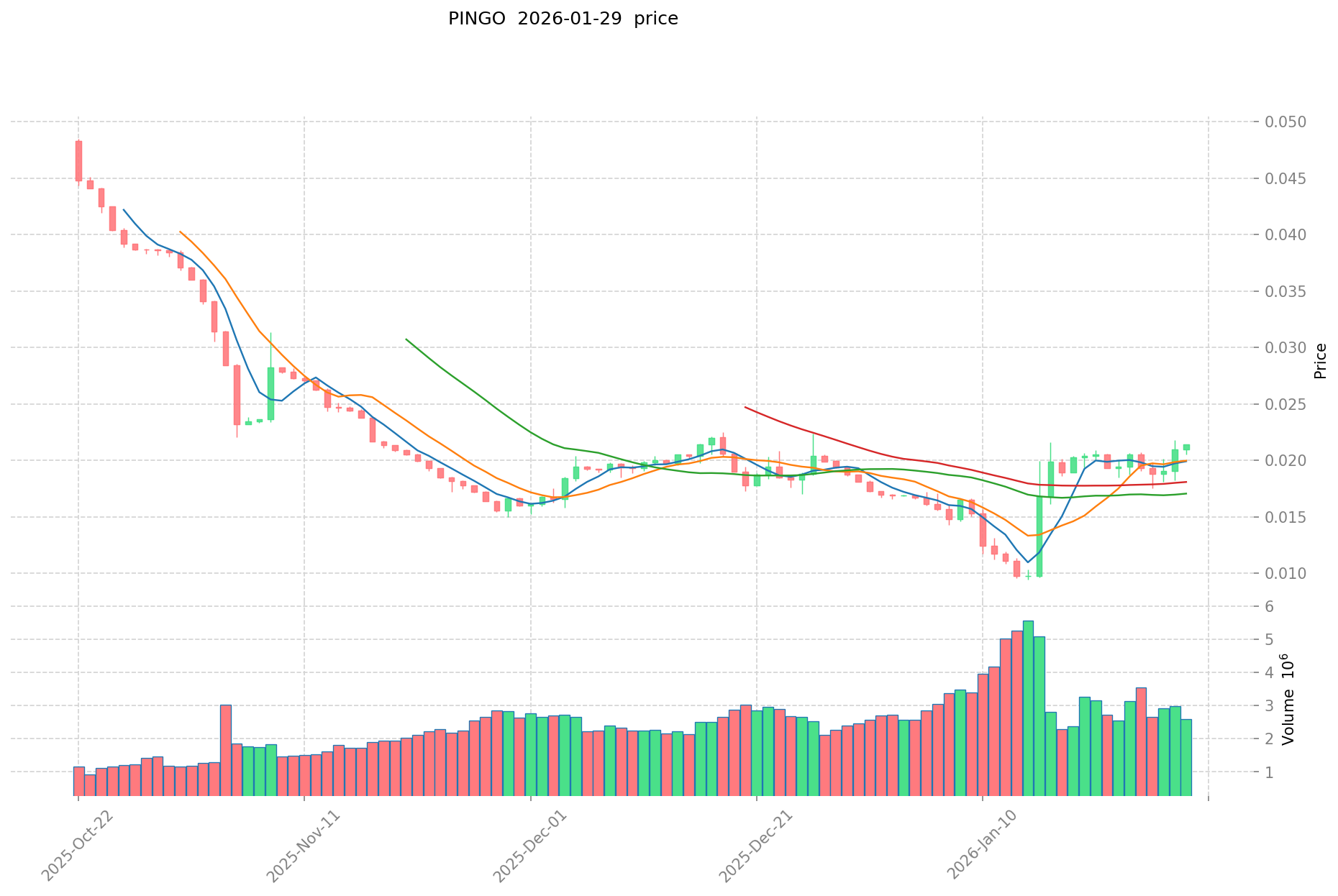
- 2025: PINGO reached a price level of $0.45 on January 6, 2025 → Price subsequently experienced volatility
- 2026: Token price declined to $0.00942 on January 14, 2026 → Market showed correction from previous levels
- Current Period: Price recovered from lower levels → Trading at $0.020665 with year-to-date decline of 94.19%
Current PINGO Investment Market Status (January 2026)
- PINGO current price: $0.020665
- Market sentiment (Fear & Greed Index): Data not available in provided materials
- 24-hour trading volume: $72,025.35
- Institutional investor holdings: Data not available in provided materials
- Token holders: 12,291 addresses
- Market capitalization: $3,823,719.34
- Circulating supply: 185,033,600 PINGO (18.50% of total supply)
- Fully diluted valuation: $20,665,000
Click to view real-time PINGO market price
II. Core Factors Influencing Whether PINGO Is a Good Investment
Supply Mechanism and Scarcity (PINGO investment scarcity)
- Total supply of 1,000,000,000 PINGO tokens with a maximum supply cap → influences price dynamics and investment value
- Current circulating supply of 185,033,600 tokens (18.5% of total supply) → indicates significant future supply potential
- Historical data shows price fluctuation between $0.00942 and $0.45 since launch in November 2024 → demonstrates volatility characteristics
- Investment significance: The fixed maximum supply may contribute to long-term value considerations, though circulating supply remains relatively limited
Technology & Ecosystem Development (Technology & Ecosystem for PINGO investment)
- AI+DePIN integration on TON network: Addresses idle computing power resource challenges → positions PINGO in emerging decentralized infrastructure sector
- PinGo MiniBot ecosystem engagement tool: Provides airdrop rewards and community interaction → enhances user participation mechanisms
- Computing power optimization platform: Integrates AI, DePIN, and Decloud solutions → supports machine learning application development
- TON network deployment: Leverages existing blockchain infrastructure → benefits from network effects and technical foundation
- Ecosystem scope: Currently listed on 1 exchange with 12,291 holders → indicates early-stage market presence
- Current market capitalization of $3,823,719 with market dominance of 0.00069% → reflects small-cap positioning
- 24-hour trading volume of $72,025 → indicates limited liquidity conditions
- Fully diluted valuation (FDV) of $20,665,000 compared to current market cap → represents potential supply expansion impact
- Price performance: +8.09% over 7 days, +13.85% over 30 days → shows recent positive momentum
- Annual performance: -94.19% decline → reflects substantial depreciation from previous levels
Project Fundamentals and Positioning
- First AI+DePIN project on TON network → occupies specific niche positioning in decentralized computing sector
- Launch price of $0.025 compared to current price of $0.020665 → trading below initial offering level
- Active development status with ongoing ecosystem participation → indicates continued project operation
- White paper and documentation available → provides technical and operational transparency
III. PINGO Future Investment Forecast and Price Outlook (Is PinGo(PINGO) worth investing in 2026-2031)
Short-term Investment Forecast (2026, short-term PINGO investment outlook)
Based on available data, PinGo's short-term performance may be influenced by market conditions and adoption momentum within the TON ecosystem.
- Conservative forecast: $0.020 - $0.021
- Neutral forecast: $0.0206 - $0.022
- Optimistic forecast: $0.021 - $0.023
Mid-term Investment Outlook (2027-2029, mid-term PinGo(PINGO) investment forecast)
- Market stage expectation: During this phase, PINGO may experience development driven by expansion in AI and DePIN integration, potentially supporting demand for decentralized computing resources.
- Investment return forecast:
- 2027: $0.011 - $0.028
- 2028: $0.019 - $0.026
- 2029: $0.023 - $0.031
- Key catalysts: Ecosystem growth on TON blockchain, partnerships in AI and machine learning sectors, and broader DePIN adoption trends.
Long-term Investment Outlook (Is PinGo a good long-term investment?)
- Base scenario: $0.018 - $0.031 (assuming steady ecosystem development and moderate market conditions)
- Optimistic scenario: $0.028 - $0.046 (assuming accelerated adoption and favorable regulatory environment)
- Risk scenario: Below $0.018 (under adverse market conditions or technological setbacks)
Click to view PINGO long-term investment and price forecast: Price Prediction
2026-01-30 - 2031 Long-term Outlook
- Base scenario: $0.018 - $0.031 (corresponding to steady progress and mainstream application growth)
- Optimistic scenario: $0.028 - $0.046 (corresponding to large-scale adoption and favorable market environment)
- Transformative scenario: Above $0.046 (if ecosystem achieves breakthrough developments and mainstream adoption)
- 2031-12-31 forecast high: $0.046 (based on optimistic development assumptions)
Disclaimer: Cryptocurrency investments carry substantial risk. Price predictions are based on historical data and market analysis tools but cannot guarantee future performance. Investors should conduct independent research and consider their risk tolerance before making investment decisions.
| Year |
Predicted High Price |
Predicted Average Price |
Predicted Low Price |
Price Change |
| 2026 |
0.02190702 |
0.020667 |
0.02004699 |
0 |
| 2027 |
0.027673113 |
0.02128701 |
0.0108563751 |
3 |
| 2028 |
0.02594886519 |
0.0244800615 |
0.019339248585 |
18 |
| 2029 |
0.03101378991435 |
0.025214463345 |
0.02294516164395 |
22 |
| 2030 |
0.03373695195561 |
0.028114126629675 |
0.017711899776695 |
36 |
| 2031 |
0.04576979815311 |
0.030925539292642 |
0.027214474577525 |
49 |
IV. PinGo Investment Strategy and Risk Management (How to invest in PinGo)
Investment Methodology (PinGo investment strategy)
Long-term Holding (HODL PinGo): This approach may suit conservative investors who believe in the project's long-term vision of decentralized computing resources and AI infrastructure on the TON network. Given PinGo's focus on bridging idle computing power through AI, DePIN, and Decloud solutions, investors following this strategy would hold tokens anticipating the ecosystem's gradual development and adoption.
Active Trading: Traders employing technical analysis and swing trading strategies should note PinGo's price movements: +0.54% (1H), -2.2% (24H), +8.09% (7D), and +13.85% (30D). The 24-hour trading range between $0.02048 and $0.021441 indicates moderate volatility suitable for short-term position management.
Risk Management (Risk management for PinGo investment)
Asset Allocation Ratios:
- Conservative investors: Consider allocating no more than 1-3% of crypto portfolio to emerging DePIN projects like PinGo
- Aggressive investors: May allocate 5-10% while maintaining broader portfolio diversification
- Professional investors: Should conduct thorough due diligence on the TON ecosystem and DePIN sector fundamentals
Risk Hedging Solutions: Investors should maintain a diversified portfolio across different blockchain networks and crypto categories. Consider balancing exposure to established networks alongside emerging infrastructure projects. Hedging strategies may include holding stablecoins or Bitcoin as portfolio anchors.
Secure Storage:
- Hot wallets: Suitable for active trading portions, ensure two-factor authentication
- Cold storage: Recommended for long-term holdings using hardware wallets compatible with TON network
- Hardware wallet options: Research TON-compatible devices or use multi-chain hardware wallets with TON support
V. PinGo Investment Risks and Challenges (Risks of investing in PinGo)
Market Risks: PinGo exhibits considerable price fluctuations, with a year-to-date change of -94.19% from its launch price of $0.025. The token reached $0.45 on January 6, 2025, but declined to $0.00942 by January 14, 2026, demonstrating extreme volatility. With a market capitalization of approximately $3.82 million and 24-hour trading volume of $72,025, lower liquidity may contribute to price manipulation risks.
Regulatory Risks: As a decentralized computing infrastructure project operating on the TON network, PinGo faces evolving regulatory frameworks surrounding:
- Decentralized infrastructure networks across different jurisdictions
- AI-related data processing and privacy regulations
- Cryptocurrency classification and compliance requirements varying by country
Technical Risks:
- Network security vulnerabilities on the TON blockchain could impact token operations
- Smart contract risks associated with the token contract at EQCRWpQQmfSglpLp6D5Xebix50AStBxjfQQNkssFP_IsiQc3
- Integration challenges between AI, DePIN, and Decloud components
- Potential technical failures in computing resource allocation mechanisms
- Ecosystem development delays affecting utility and adoption
VI. Conclusion: Is PinGo a Good Investment?
Investment Value Summary: PinGo represents an early-stage project combining AI, decentralized infrastructure, and computing resource optimization on the TON network. With 18.5% of total supply in circulation (185 million out of 1 billion tokens) and approximately 12,291 holders, the project remains in early adoption phases. The market cap to fully diluted valuation ratio of 18.5% suggests substantial token unlock considerations for future price dynamics.
Investor Recommendations:
✅ Beginners: Consider dollar-cost averaging with small allocations and store tokens in secure wallets compatible with TON network. Familiarize yourself with DePIN concepts before investing.
✅ Experienced Investors: May explore swing trading opportunities based on technical patterns while maintaining strict position sizing. Monitor developments in the TON ecosystem and competing DePIN projects.
✅ Institutional Investors: Should conduct comprehensive due diligence on the computing resource market, AI infrastructure demand, and PinGo's technological differentiation within the DePIN sector.
⚠️ Disclaimer: Cryptocurrency investments carry substantial risks, including potential complete loss of capital. This content is for informational purposes only and does not constitute investment advice. Conduct independent research and consult financial advisors before making investment decisions.
VII. FAQ
Q1: What is the current circulating supply of PINGO tokens and how might future token unlocks affect price?
Currently, 185.03 million PINGO tokens are in circulation, representing only 18.5% of the total supply of 1 billion tokens. This means approximately 81.5% of tokens remain locked or unreleased, which presents a significant supply overhang. Future token unlocks could create substantial selling pressure as the circulating supply increases. The fully diluted valuation of $20.67 million compared to the current market cap of $3.82 million illustrates this potential dilution risk. Investors should monitor token release schedules and vesting periods, as gradual unlocks may suppress price appreciation even during periods of positive development. The low current circulation percentage is typical of early-stage projects but requires careful consideration when evaluating long-term price potential.
Q2: How does PINGO's technology distinguish itself within the DePIN sector?
PINGO positions itself as the first AI+DePIN project on the TON network, integrating artificial intelligence with decentralized physical infrastructure networks and decentralized cloud solutions. The platform addresses idle computing power fragmentation by creating a marketplace that connects unused computational resources with machine learning applications and AI workloads. Unlike traditional DePIN projects that focus solely on single infrastructure categories, PINGO's approach combines multiple layers: AI optimization algorithms, decentralized computing resource allocation, and cloud infrastructure integration. The project operates through the TON blockchain infrastructure, potentially benefiting from TON's network effects and technical foundation. However, the competitive landscape includes established players in decentralized computing, and PINGO's technological differentiation requires ongoing development to maintain its market position.
Q3: What explains PINGO's 94.19% price decline from its peak, and what are the recovery prospects?
PINGO experienced a dramatic price correction from $0.45 in early January 2025 to $0.00942 by January 14, 2026, representing a 94.19% decline. Several factors contributed to this downturn: the broader cryptocurrency market correction during this period, limited liquidity with only $72,025 in 24-hour trading volume, early-stage project risks, and potential profit-taking after initial token distribution. The token has shown recent positive momentum with +8.09% gains over 7 days and +13.85% over 30 days, suggesting some stabilization. Recovery prospects depend on ecosystem development milestones, increased adoption of the computing resource platform, expansion to additional exchanges for improved liquidity, and overall market sentiment toward AI and DePIN projects. The conservative forecast suggests gradual recovery toward $0.021-$0.023 in the short term, though significant volatility should be expected.
Q4: What is the minimum recommended investment allocation for PINGO in a diversified crypto portfolio?
Conservative investors should consider allocating no more than 1-3% of their cryptocurrency portfolio to PINGO, given its early-stage status, high volatility, and limited market capitalization of $3.82 million. More aggressive investors might allocate 5-10%, though this requires acceptance of substantial downside risk. The allocation should reflect PINGO's position as a speculative, small-cap project rather than an established digital asset. Portfolio construction should maintain diversification across different blockchain networks, market capitalizations, and crypto categories. For context, PINGO's market dominance stands at only 0.00069%, indicating minimal systemic importance. Investors should only commit capital they can afford to lose entirely, as the project faces technological execution risks, competition from established DePIN networks, and the challenges inherent in early adoption phases. Regular portfolio rebalancing is recommended to maintain target allocation percentages as prices fluctuate.
Q5: How does trading volume affect PINGO's investment suitability for different investor types?
PINGO's 24-hour trading volume of approximately $72,025 indicates limited liquidity, which significantly impacts investment suitability across different investor profiles. For retail investors making small purchases ($100-$1,000), this liquidity level may be adequate for position entry, though exit timing becomes critical during market stress. Swing traders and active investors face challenges with slippage and spread costs, as low volume can cause price deviation between intended and executed trades. Larger investors or institutions require substantially higher daily volumes to enter or exit positions without moving the market significantly. The volume-to-market-cap ratio suggests thin order books, meaning individual trades can disproportionately affect price. The project is currently listed on only one exchange, limiting arbitrage opportunities and price discovery mechanisms. Investors should use limit orders rather than market orders, split large purchases across multiple transactions, and avoid trading during low-activity periods to minimize adverse price impact.
Q6: What regulatory considerations should international investors evaluate before investing in PINGO?
International investors must navigate several regulatory dimensions specific to PINGO's operational model. As a decentralized computing infrastructure project, PINGO operates at the intersection of cryptocurrency regulations, data processing laws, and AI governance frameworks that vary significantly across jurisdictions. The project's focus on computing resource allocation may trigger data sovereignty requirements in regions like the European Union (GDPR), requiring careful consideration of where computational resources are located and how data is processed. Different countries classify utility tokens differently—some as securities, others as commodities or digital assets—affecting tax treatment and compliance obligations. The TON network's regulatory history and evolving status in various jurisdictions adds another layer of consideration. Investors in the United States should evaluate whether PINGO tokens might be considered securities under Howey Test criteria, while Asian investors must consider varying approaches from complete prohibition to regulated acceptance. Before investing, conduct jurisdiction-specific research, consult tax professionals familiar with cryptocurrency regulations, and monitor announcements from relevant regulatory bodies regarding DePIN projects and AI infrastructure tokens.
Q7: What technical indicators suggest optimal entry and exit points for PINGO trading strategies?
Recent price performance shows PINGO exhibiting short-term positive momentum with +8.09% gains over 7 days and +13.85% over 30 days, suggesting recovery from the January 14, 2026 low of $0.00942. The 24-hour trading range between $0.02048 and $0.021441 indicates approximately 4.6% intraday volatility, providing opportunities for range-bound trading strategies. Technical traders should monitor key support at the $0.019-$0.020 level, which represents the lower bound of recent consolidation, and resistance near $0.022-$0.023 where selling pressure may emerge. The substantial decline from the all-time high of $0.45 means overhead supply likely exists at multiple price levels as previous buyers seek exit opportunities. Volume analysis becomes critical given the low daily volume of $72,025—breakouts should be confirmed with accompanying volume increases to validate trend strength. Moving average crossovers and RSI indicators may provide additional signals, though low liquidity can produce false signals. Traders should implement strict stop-loss orders to manage downside risk, consider position sizing relative to daily volume to avoid market impact, and remain aware that technical patterns in low-liquidity assets carry higher failure rates than in established markets.
Q8: How does PINGO's holder count of 12,291 addresses indicate adoption status and investment implications?
The current holder count of 12,291 addresses provides important context for PINGO's adoption trajectory and network effects. This figure represents an early-stage user base, suggesting the project remains in initial distribution and awareness phases rather than mainstream adoption. For comparison, established DePIN projects often measure holders in the hundreds of thousands or millions, indicating PINGO has substantial growth potential if the ecosystem develops successfully. The holder distribution pattern matters significantly—concentration among few addresses suggests whale dominance and manipulation risk, while broader distribution indicates healthier decentralization. The ratio of holders to total supply (12,291 holders for 1 billion tokens) suggests average holdings of approximately 81,200 tokens per address, though actual distribution is likely highly skewed with large holders and many smaller retail positions. Growth in holder count serves as a leading indicator of ecosystem expansion and can correlate with price appreciation when accompanied by genuine usage metrics. Investors should monitor holder growth trends, on-chain activity patterns, and the ratio of active versus inactive addresses to assess whether the community is expanding organically or remaining stagnant despite marketing efforts.
* The information is not intended to be and does not constitute financial advice or any other recommendation of any sort offered or endorsed by Gate.